Identification
- Summary
Magnesium oxide is a compound commonly used as a laxative for the symptomatic relief of acid indigestion and upset stomach, and in health supplements for cardiovascular and neuromuscular health.
- Brand Names
- Clenpiq, Diphen, Pico-salax, Picoflo, Pregvit, Purg-odan
- Generic Name
- Magnesium oxide
- DrugBank Accession Number
- DB01377
- Background
Magnesium oxide is an inorganic compound that occurs in nature as the mineral periclase. In aqueous media combines quickly with water to form magnesium hydroxide. It is used as an antacid and mild laxative and has many nonmedicinal uses.
- Type
- Small Molecule
- Groups
- Approved
- Structure
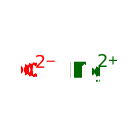
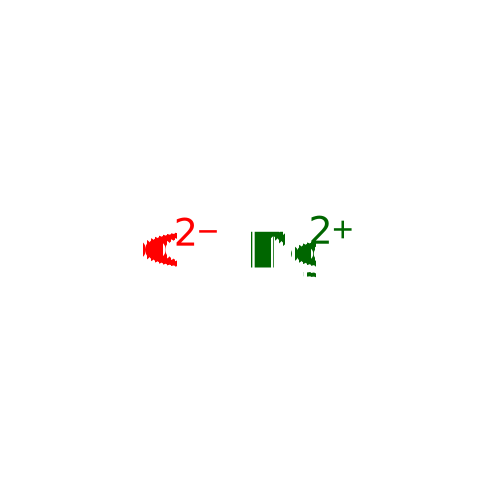
Structure for Magnesium oxide (DB01377)
- Weight
- Average: 40.304
Monoisotopic: 39.97995652 - Chemical Formula
- MgO
- Synonyms
- Magnesia
- Magnesium oxide
- External IDs
- E-530
- INS NO.530
- INS-530

Pharmacology
- Indication
Indicated for over-the-counter use as a supplement for cardiovascular and neuromuscular health, and as an antacid for relief of acid indigestion and upset stomach.
Magnesium oxide, in combination with sodium picosulfate and anhydrous citric acid, is indicated for cleansing of the colon as a preparation for colonoscopy in adults and pediatric patients ages 9 years and older.3
 Reduce drug development failure ratesBuild, train, & validate machine-learning modelswith evidence-based and structured datasets.Build, train, & validate predictive machine-learning models with structured datasets.
- Associated Conditions
Indication Type Indication Combined Product Details Approval Level Age Group Patient Characteristics Dose Form Symptomatic treatment of Acid indigestion ••• ••• Symptomatic treatment of Heartburn ••• ••• - Associated Therapies
- Contraindications & Blackbox Warnings
 Prevent Adverse Drug Events TodayTap into our Clinical API for life-saving information on contraindications & blackbox warnings, population restrictions, harmful risks, & more.Avoid life-threatening adverse drug events with our Clinical API
- Pharmacodynamics
Not Available
- Mechanism of action
The term "Milk of Magnesia" was first used to describe a white aqueous, mildly alkaline suspension of magnesium hydroxide formulated at about 8%w/v. Milk of magnesia is primarily used to alleviate constipation, but can also be used to relieve indigestion and heartburn. When taken internally by mouth as a laxative, the osmotic force of the magnesia suspension acts to draw fluids from the body and to retain those already within the lumen of the intestine, serving to distend the bowel, thus stimulating nerves within the colon wall, inducing peristalsis and resulting in evacuation of colonic contents. Magnesium supplements have also been shown to reduce platelet aggregation by inhibiting in the influx of calcium, a crucial component of platelet aggregation.
- Absorption
Not Available
- Volume of distribution
Not Available
- Protein binding
Not Available
- Metabolism
- Not Available
- Route of elimination
Not Available
- Half-life
Not Available
- Clearance
Not Available
- Adverse Effects
 Improve decision support & research outcomesWith structured adverse effects data, including: blackbox warnings, adverse reactions, warning & precautions, & incidence rates. View sample adverse effects data in our new Data Library!Improve decision support & research outcomes with our structured adverse effects data.
- Toxicity
Not Available
- Pathways
- Not Available
- Pharmacogenomic Effects/ADRs
- Not Available
Interactions
- Drug Interactions
- This information should not be interpreted without the help of a healthcare provider. If you believe you are experiencing an interaction, contact a healthcare provider immediately. The absence of an interaction does not necessarily mean no interactions exist.
Drug Interaction Integrate drug-drug
interactions in your softwareAcetaminophen Magnesium oxide can cause a decrease in the absorption of Acetaminophen resulting in a reduced serum concentration and potentially a decrease in efficacy. Acetazolamide The risk or severity of dehydration can be increased when Acetazolamide is combined with Magnesium oxide. Acetophenazine Magnesium oxide can cause a decrease in the absorption of Acetophenazine resulting in a reduced serum concentration and potentially a decrease in efficacy. Aclidinium The therapeutic efficacy of Magnesium oxide can be decreased when used in combination with Aclidinium. Alendronic acid The serum concentration of Alendronic acid can be decreased when it is combined with Magnesium oxide. - Food Interactions
- Take with food. When using magnesium to treat calcium oxalate nephrolithiasis, magnesium oxide should be taken with food.
- Take with or without food. Many different products contain magnesium oxide; refer to the product monograph for more specific instruction. Taking magnesium supplements with food may reduce the risk of diarrhea.
Products
 Drug product information from 10+ global regionsOur datasets provide approved product information including:dosage, form, labeller, route of administration, and marketing period.Access drug product information from over 10 global regions.
- Active Moieties
Name Kind UNII CAS InChI Key Magnesium cation ionic T6V3LHY838 22537-22-0 JLVVSXFLKOJNIY-UHFFFAOYSA-N Magnesium unknown I38ZP9992A 7439-95-4 RSHAOIXHUHAZPM-UHFFFAOYSA-N - Product Images

- International/Other Brands
- Magmitt
- Over the Counter Products
Name Dosage Strength Route Labeller Marketing Start Marketing End Region Image Antacid Tablet 400 mg/1 Oral Spirit Pharmaceuticals LLC 2021-11-16 Not applicable US 
Magnelis Capsule 165 mg / cap Oral Import Export SantÉ Nature Inc. 1999-02-20 2003-08-01 Canada 
Magnesium 250mg Tab Tablet 250 mg / tab Oral Bioforce Canada Inc. 1994-12-31 1997-07-22 Canada Magnesium Oxide Tablet 253 mg/1 Oral Par Pharmaceuticals 2020-11-10 Not applicable US Magnesium Oxide Tablet 400 mg/1 Oral Virtus Pharmaceuticals 2014-04-09 2016-10-04 US - Mixture Products
Name Ingredients Dosage Route Labeller Marketing Start Marketing End Region Image Anaplex Tab Magnesium oxide (50 mg / tab) + Ascorbic acid (40 mg / tab) + Calcium (160 mg / tab) + Iodine (.05 mg / tab) + Nicotinamide (30 mg / tab) + Calcium pantothenate (15 mg / tab) + Phosphorus (75.33 mg / tab) + Potassium chloride (20 mg / tab) + Pyridoxine hydrochloride (40 mg / tab) + Vitamin A palmitate (2000 unit / tab) + Vitamin D (133.33 unit / tab) Tablet Oral Anabolic Laboratories Inc. 1975-12-31 1996-10-02 Canada Armax Magnesium oxide (50 mg) + Ascorbic acid (15 mg) + Manganese (1.5 mg) + Niacin (15 mg) + Nicotinamide (150 mg) + Calcium pantothenate (50 mg) + Zinc (1.5 mg) Tablet Oral Enzymatic Therapy, Inc. 1997-03-20 2001-08-02 Canada Aspirin Plus Stomach Guard Ext.stgth.caplet Magnesium oxide (96.9 mg / tab) + Acetylsalicylic acid (500 mg / tab) + Calcium carbonate (246.2 mg / tab) + Magnesium carbonate (52.3 mg / tab) Tablet Oral Sterling Winthrop Inc. 1994-12-31 1996-09-10 Canada Aspirin Plus Stomach Guard Extra Strength Magnesium oxide (96.95 mg / tab) + Acetylsalicylic acid (500 mg / tab) + Calcium carbonate (246.22 mg / tab) + Magnesium carbonate (52.32 mg / tab) Tablet Oral Bayer Inc Consumer Care 1995-12-31 1998-09-28 Canada Aspirin Plus Stomach Guard Tab Magnesium oxide (63 mg / tab) + Acetylsalicylic acid (325 mg / tab) + Calcium carbonate (160 mg / tab) + Magnesium carbonate (34 mg / tab) Tablet Oral Sterling Winthrop Inc. 1994-12-31 1996-09-10 Canada - Unapproved/Other Products
Name Ingredients Dosage Route Labeller Marketing Start Marketing End Region Image Abavite Magnesium oxide (25 mg/1) + Ascorbic acid (60 mg/1) + Cholecalciferol (0.025 mg/1) + DL-alpha tocopheryl acetate (13.5 mg/1) + Ferrous sulfate (30 mg/1) + Folic acid (1 mg/1) + Mecobalamin (0.5 mg/1) + Niacin (15 mg/1) + Calcium pantothenate (5 mg/1) + Potassium Iodide (0.25 mg/1) + Riboflavin (1.8 mg/1) + Thiamine mononitrate (1.6 mg/1) + Vitamin A palmitate (0.33 mg/1) + Zinc oxide (15 mg/1) Tablet Oral ABACOS HEALTH 2021-03-31 Not applicable US Active FE Magnesium oxide (30 mg/1) + Ascorbic acid (160 mg/1) + Beta carotene (2100 [iU]/1) + Cholecalciferol (400 [iU]/1) + Cupric oxide (1 mg/1) + Cyanocobalamin (30 ug/1) + DL-alpha tocopheryl acetate (40 [iU]/1) + Folic acid (1250 ug/1) + Iron (75 mg/1) + Nicotinamide (20 mg/1) + Pyridoxine hydrochloride (20 mg/1) + Riboflavin (4 mg/1) + Thiamine hydrochloride (4 mg/1) + Zinc oxide (20 mg/1) Tablet Oral Gm Pharmaceuticals 2013-11-11 Not applicable US Bacmin Magnesium oxide (50 mg/1) + Ascorbic acid (500 mg/1) + Biotin (150 ug/1) + Chromium Cr-51 chloride (0.1 mg/1) + Cupric oxide (3 mg/1) + Cyanocobalamin (50 ug/1) + Ferrous fumarate (27 mg/1) + Flavone (50 mg/1) + Folic acid (1 mg/1) + Manganese gluconate (5 mg/1) + Nicotinamide (100 mg/1) + Calcium pantothenate (25 mg/1) + Pyridoxine hydrochloride (25 mg/1) + Riboflavin (20 mg/1) + Selenomethionine (50 ug/1) + Thiamine mononitrate (20 mg/1) + Vitamin A acetate (2000 [iU]/1) + Zinc oxide (22.5 mg/1) + alpha-Tocopherol acetate (30 [iU]/1) Tablet, coated Oral Marnel Pharmaceuticals, Llc 2000-04-01 Not applicable US Bal-Care DHA Magnesium oxide (25 mg/1) + Ascorbic acid (120 mg/1) + Beta carotene (2850 [iU]/1) + Calcium carbonate (219 mg/1) + Cholecalciferol (840 [iU]/1) + Cupric oxide (2 mg/1) + Cyanocobalamin (.012 mg/1) + DL-alpha tocopheryl acetate (3 mg/1) + Folic acid (1 mg/1) + Iodine (.223 mg/1) + Iron sucrose (1.35 mg/1) + Nicotinamide (20 mg/1) + Omega-3 fatty acids (430 mg/1) + Pyridoxine hydrochloride (50 mg/1) + Riboflavin (4 mg/1) + Sodium feredetate (25.65 mg/1) + Thiamine mononitrate (1.8 mg/1) + Zinc oxide (25 mg/1) Kit Oral Pru Gen Pharmaceuticals 2012-05-01 Not applicable US Bal-Care DHA Essential Magnesium oxide (25 mg/1) + Ascorbic acid (120 mg/1) + Beta carotene (2850 [iU]/1) + Calcium carbonate (219 mg/1) + Cholecalciferol (840 [iU]/1) + Cupric oxide (2 mg/1) + Cyanocobalamin (.012 mg/1) + DL-alpha tocopheryl acetate (3 mg/1) + Folic acid (1 mg/1) + Iodine (.223 mg/1) + Iron sucrose (1.35 mg/1) + Nicotinamide (20 mg/1) + Omega-3 fatty acids (374 mg/1) + Pyridoxine hydrochloride (50 mg/1) + Riboflavin (4 mg/1) + Sodium feredetate (25.65 mg/1) + Thiamine mononitrate (1.8 mg/1) + Zinc oxide (25 mg/1) Kit Oral Pru Gen Pharmaceuticals 2012-05-01 Not applicable US

Categories
- ATC Codes
- A02AA02 — Magnesium oxide
- A02AA — Magnesium compounds
- A02A — ANTACIDS
- A02 — DRUGS FOR ACID RELATED DISORDERS
- A — ALIMENTARY TRACT AND METABOLISM
- A12CC — Magnesium
- A12C — OTHER MINERAL SUPPLEMENTS
- A12 — MINERAL SUPPLEMENTS
- A — ALIMENTARY TRACT AND METABOLISM
- Drug Categories
- Agents that produce neuromuscular block (indirect)
- Alimentary Tract and Metabolism
- Aluminum and magnesium containing antacids
- Antacids
- Drugs for Acid Related Disorders
- Drugs for Constipation
- Gastric Acid Lowering Agents
- Gastrointestinal Agents
- Laxatives
- Laxatives, magnesium containing
- Magnesium Compounds
- Magnesium Salts
- Metal cations
- Metal divalent cations
- Mineral Supplements
- Minerals
- Osmotic Laxatives
- Oxides
- Oxygen Compounds
- Classification
- Not classified
- Affected organisms
- Not Available
Chemical Identifiers
- UNII
- 3A3U0GI71G
- CAS number
- 1309-48-4
- InChI Key
- AXZKOIWUVFPNLO-UHFFFAOYSA-N
- InChI
- InChI=1S/Mg.O/q+2;-2
- IUPAC Name
- magnesium(2+) oxidandiide
- SMILES
- [O--].[Mg++]
References
- Synthesis Reference
Jajnya D. Panda, Santosh K. Mahapatra, "Process for the production of magnesium oxide from brine or bittern." U.S. Patent US4370422, issued June, 1921.
US4370422- General References
- Kh R, Khullar M, Kashyap M, Pandhi P, Uppal R: Effect of oral magnesium supplementation on blood pressure, platelet aggregation and calcium handling in deoxycorticosterone acetate induced hypertension in rats. J Hypertens. 2000 Jul;18(7):919-26. [Article]
- Shechter M, Merz CN, Paul-Labrador M, Meisel SR, Rude RK, Molloy MD, Dwyer JH, Shah PK, Kaul S: Oral magnesium supplementation inhibits platelet-dependent thrombosis in patients with coronary artery disease. Am J Cardiol. 1999 Jul 15;84(2):152-6. [Article]
- FDA Approved Drug Products: CLENPIQ (sodium picosulfate, magnesium oxide, and anhydrous citric acid) oral solution [Link]
- External Links
- Human Metabolome Database
- HMDB0303510
- KEGG Drug
- D01167
- KEGG Compound
- C12567
- PubChem Compound
- 14792
- PubChem Substance
- 46504815
- ChemSpider
- 5254017
- 6582
- ChEBI
- 31794
- ChEMBL
- CHEMBL1200572
- PharmGKB
- PA450298
- Drugs.com
- Drugs.com Drug Page
- Wikipedia
- Magnesia
Clinical Trials
- Clinical Trials
Phase Status Purpose Conditions Count 4 Completed Not Available Bowel preparation therapy 1 4 Completed Diagnostic Colonoscopy 1 4 Completed Diagnostic Hemodynamics / Hyponatremia 1 4 Completed Screening Colorectal Cancer 1 4 Completed Supportive Care Colon Cancer 1
Pharmacoeconomics
- Manufacturers
- Not Available
- Packagers
- Bayer Healthcare
- Blaine Pharmaceuticals
- Gallipot
- Major Pharmaceuticals
- Manne Co.
- Mckesson Corp.
- Particle Dynamics Co.
- Qualitest
- Rising Pharmaceuticals
- Rugby Laboratories
- Walgreen Co.
- Dosage Forms
Form Route Strength Tablet Oral 243 mg Powder, for solution Oral Powder Parenteral 1 g/50g Kit Oral Kit Not applicable Tablet, film coated Powder Oral Cream; kit; liquid; ointment; tablet; tablet, chewable; tablet, film coated Oral; Topical Tablet Oral Tablet, effervescent Oral Capsule, liquid filled; kit; tablet Oral Tablet Oral 200 mg Tablet, coated Oral Capsule, coated Oral Granule Oral Capsule Oral 165 mg / cap Tablet Oral 250 mg / tab Capsule Oral 250 mg Tablet Oral 241.3 mg/1000mg Tablet Oral 253 mg/1 Tablet Oral 400 mg/1 Tablet Oral 420 mg/1 Tablet Oral 250 mg Powder 1 kg/1kg Powder Oral 240 mg / mL Tablet Oral 252 mg / tab Tablet Oral 420 mg Tablet Oral 70 mg / tab Tablet Oral 410 mg Powder, for solution Oral 100 g Capsule Oral 150 mg Granule, for solution Oral Capsule Oral Capsule, liquid filled; kit; tablet, film coated Oral Powder, for solution Oral 12 g Capsule, gelatin coated Oral Powder, metered Oral Pill Oral Liquid Oral Wafer Oral Granule Capsule; kit; tablet, coated Oral Capsule; kit; tablet, film coated Oral Solution Irrigation Liquid Irrigation Capsule; kit; tablet Oral Tablet, film coated Oral Tablet, chewable Oral Capsule, liquid filled Oral Capsule, gelatin coated; kit; tablet Oral Powder Suspension Capsule Oral 84.5 mg - Prices
Unit description Cost Unit Phillips 500 mg caplet 0.18USD caplet Magnesium oxide 400 mg tablet 0.13USD tablet Magnesium oxide 420 mg tablet 0.11USD tablet Magox 400 tablet 0.11USD tablet Mag-oxide 400 mg tablet 0.09USD tablet Magnesium oxide powder heavy 0.05USD g Magnesium oxide 500 mg tablet 0.04USD tablet Maox 420 mg tablet 0.04USD tablet Magnesium oxide 250 mg tablet 0.03USD tablet DrugBank does not sell nor buy drugs. Pricing information is supplied for informational purposes only.- Patents
Patent Number Pediatric Extension Approved Expires (estimated) Region US8450338 No 2013-05-28 2028-10-10 US US8481083 No 2013-07-09 2028-10-10 US US9827231 No 2017-11-28 2034-06-23 US US10624879 No 2020-04-21 2034-06-23 US US11191753 No 2021-12-07 2034-06-23 US
Properties
- State
- Solid
- Experimental Properties
- Not Available
- Predicted Properties
Property Value Source logP -0.57 Chemaxon pKa (Strongest Acidic) 3.09 Chemaxon Physiological Charge 2 Chemaxon Hydrogen Acceptor Count 0 Chemaxon Hydrogen Donor Count 0 Chemaxon Polar Surface Area 0 Å2 Chemaxon Rotatable Bond Count 0 Chemaxon Refractivity 0 m3·mol-1 Chemaxon Polarizability 1.78 Å3 Chemaxon Number of Rings 0 Chemaxon Bioavailability 1 Chemaxon Rule of Five Yes Chemaxon Ghose Filter No Chemaxon Veber's Rule Yes Chemaxon MDDR-like Rule No Chemaxon - Predicted ADMET Features
Property Value Probability Human Intestinal Absorption + 0.9838 Blood Brain Barrier + 0.9837 Caco-2 permeable + 0.6708 P-glycoprotein substrate Non-substrate 0.8922 P-glycoprotein inhibitor I Non-inhibitor 0.9725 P-glycoprotein inhibitor II Non-inhibitor 0.995 Renal organic cation transporter Non-inhibitor 0.9248 CYP450 2C9 substrate Non-substrate 0.8638 CYP450 2D6 substrate Non-substrate 0.894 CYP450 3A4 substrate Non-substrate 0.8026 CYP450 1A2 substrate Non-inhibitor 0.8153 CYP450 2C9 inhibitor Non-inhibitor 0.9268 CYP450 2D6 inhibitor Non-inhibitor 0.9535 CYP450 2C19 inhibitor Non-inhibitor 0.9338 CYP450 3A4 inhibitor Non-inhibitor 0.9869 CYP450 inhibitory promiscuity Low CYP Inhibitory Promiscuity 0.9062 Ames test Non AMES toxic 0.7478 Carcinogenicity Carcinogens 0.7198 Biodegradation Ready biodegradable 0.7705 Rat acute toxicity 2.2618 LD50, mol/kg Not applicable hERG inhibition (predictor I) Weak inhibitor 0.9031 hERG inhibition (predictor II) Non-inhibitor 0.977
Spectra
- Mass Spec (NIST)
- Not Available
- Spectra
- Not Available
- Chromatographic Properties
Collision Cross Sections (CCS)
Not Available

Drug created at July 06, 2007 20:30 / Updated at April 27, 2024 09:44