Identification
- Summary
Calcium acetate is a phosphate binder used in patients with end-stage renal disease (ESRD) to prevent elevated phosphate levels and resulting ectopic calcification and secondary hyperparathyroidism.
- Brand Names
- Domeboro, Eliphos, Phoslo, Phoslyra, Procalamine 3
- Generic Name
- Calcium acetate
- DrugBank Accession Number
- DB00258
- Background
The chemical compound calcium acetate is the calcium salt of acetic acid. It has been commonly referred to as the acetate of lime. The anhydrous form is very hygroscopic, therefore the monohydrate is the common form.
- Type
- Small Molecule
- Groups
- Approved, Investigational
- Structure
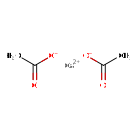
Structure for Calcium acetate (DB00258)
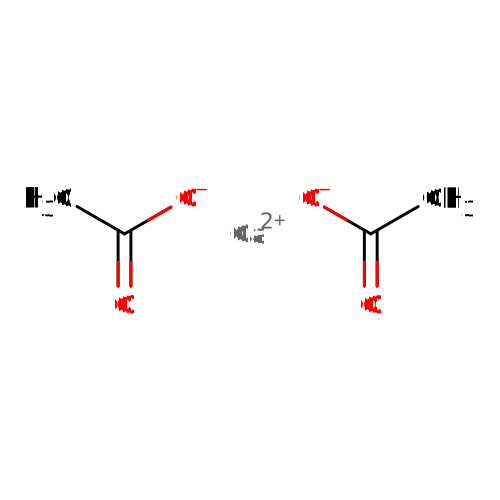
- Weight
- Average: 158.166
Monoisotopic: 157.989199835 - Chemical Formula
- C4H6CaO4
- Synonyms
- Acetate of lime
- Brown acetate of lime
- Calcio acetato
- Calcium acetate
- calcium ethanoate
- calcium(II) acetate
- Gray acetate of lime
- Lime acetate
- Lime pyrolignite
- External IDs
- E-263
- FEMA NO. 2228
- INS NO.263
- INS-263

Pharmacology
- Indication
Calcium acetate is one of a number of calcium salts used to treat hyperphosphatemia (too much phosphate in the blood) in patients with kidney disease.
 Reduce drug development failure ratesBuild, train, & validate machine-learning modelswith evidence-based and structured datasets.Build, train, & validate predictive machine-learning models with structured datasets.
- Associated Conditions
Indication Type Indication Combined Product Details Approval Level Age Group Patient Characteristics Dose Form Management of Hyperphosphatemia •••••••••••• Used in combination to treat High phosphate levels Combination Product in combination with: Magnesium carbonate (DB09481) •••••••••••• •••••••• ••••••• - Associated Therapies
- Contraindications & Blackbox Warnings
 Prevent Adverse Drug Events TodayTap into our Clinical API for life-saving information on contraindications & blackbox warnings, population restrictions, harmful risks, & more.Avoid life-threatening adverse drug events with our Clinical API
- Pharmacodynamics
Patients with advanced renal insufficiency (creatinine clearance less than 30 ml/min) exhibit phosphate retention and some degree of hyperphosphatemia. The retention of phosphate plays a pivotal role in causing secondary hyperparathyroidism associated with osteodystrophy, and soft-tissue calcification. The mechanism by which phosphate retention leads to hyperparathyroidism is not clearly delineated. Therapeutic efforts directed toward the control of hyperphosphatemia include reduction in the dietary intake of phosphate, inhibition of absorption of phosphate in the intestine with phosphate binders, and removal of phosphate from the body by more efficient methods of dialysis. The rate of removal of phosphate by dietary manipulation or by dialysis is insufficient. Dialysis patients absorb 40% to 80% of dietary phosphorus. Therefore, the fraction of dietary phosphate absorbed from the diet needs to be reduced by using phosphate binders in most renal failure patients on maintenance dialysis. Calcium acetate when taken with meals combines with dietary phosphate to form insoluble calcium phosphate which is excreted in the feces. Maintenance of serum phosphorus below 6.0 mg/dl is generally considered as a clinically acceptable outcome of treatment with phosphate binders. Calcium acetate is highly soluble at neutral pH, making the calcium readily available for binding to phosphate in the proximal small intestine.
- Mechanism of action
Calcium acetate and other calcium salts are phosphate binders. They work by binding with the phosphate in the food you eat, so that it is eliminated from the body without being absorbed.
Target Actions Organism APhosphate binderHumans - Absorption
40% is absorbed in the fasting state and approximately 30% is absorbed in the nonfasting state following oral administration.
- Volume of distribution
Not Available
- Protein binding
Not Available
- Metabolism
- Not Available
- Route of elimination
Calcium acetate when taken with meals, combines with dietary phosphate to form insoluble calcium phosphate which is excreted in the feces.
- Half-life
Not Available
- Clearance
Not Available
- Adverse Effects
 Improve decision support & research outcomesWith structured adverse effects data, including: blackbox warnings, adverse reactions, warning & precautions, & incidence rates. View sample adverse effects data in our new Data Library!Improve decision support & research outcomes with our structured adverse effects data.
- Toxicity
Oral, rat: LD50 = 4280 mg/kg. Symptoms of overdose include mild hypercalcemia (constipation; loss of appetite; nausea and vomiting), and severe hypercalcemia (confusion; full or partial loss of consciousness; incoherent speech).
- Pathways
- Not Available
- Pharmacogenomic Effects/ADRs
- Not Available
Interactions
- Drug Interactions
- This information should not be interpreted without the help of a healthcare provider. If you believe you are experiencing an interaction, contact a healthcare provider immediately. The absence of an interaction does not necessarily mean no interactions exist.
Drug Interaction Integrate drug-drug
interactions in your softwareAcebutolol The therapeutic efficacy of Acebutolol can be decreased when used in combination with Calcium acetate. Acetyldigitoxin Calcium acetate may increase the arrhythmogenic and cardiotoxic activities of Acetyldigitoxin. Alendronic acid The serum concentration of Alendronic acid can be decreased when it is combined with Calcium acetate. Alfacalcidol The risk or severity of adverse effects can be increased when Alfacalcidol is combined with Calcium acetate. Amiodarone The therapeutic efficacy of Amiodarone can be decreased when used in combination with Calcium acetate. - Food Interactions
- Take with food. When taken with food, calcium acetate forms an insoluble complex with the phosphorus from food, reducing phosphorus serum concentrations.
Products
 Drug product information from 10+ global regionsOur datasets provide approved product information including:dosage, form, labeller, route of administration, and marketing period.Access drug product information from over 10 global regions.
- Product Ingredients
Ingredient UNII CAS InChI Key Calcium acetate monohydrate 7ZA48GIM5H 5743-26-0 XQKKWWCELHKGKB-UHFFFAOYSA-L - Active Moieties
Name Kind UNII CAS InChI Key Calcium prodrug SY7Q814VUP 7440-70-2 OYPRJOBELJOOCE-UHFFFAOYSA-N Calcium cation ionic 2M83C4R6ZB 14127-61-8 BHPQYMZQTOCNFJ-UHFFFAOYSA-N Acetate ionic 569DQM74SC 71-50-1 QTBSBXVTEAMEQO-UHFFFAOYSA-M - Product Images
- International/Other Brands
- Phoslo / Teltozan
- Brand Name Prescription Products
Name Dosage Strength Route Labeller Marketing Start Marketing End Region Image PhosLo Capsule 667 mg/1 Oral Fresenius Medical Care North America 2001-04-02 Not applicable US 
Phoslo Tablet 667 mg/1 Oral Nabi Biopharmaceuticals 2007-01-01 Not applicable US Phoslo Capsule 667 mg/1 Oral Physicians Total Care, Inc. 1997-08-27 2006-10-11 US 
Phoslo Capsule 667 mg/1 Oral Nabi Biopharmaceuticals 2007-01-01 2007-06-14 US Phoslo Capsule 667 mg/1 Oral Cardinal Health 2001-04-02 2012-02-29 US 
- Generic Prescription Products
Name Dosage Strength Route Labeller Marketing Start Marketing End Region Image Calcium Acetate Capsule 667 mg/1 Oral Lotus Pharmaceutical Co., Ltd. Nantou Plant 2016-09-01 Not applicable US Calcium Acetate Tablet 667 mg/1 Oral Heritage Pharmaceuticals Inc. d/b/a Avet Pharmaceuticals Inc. 2015-01-22 Not applicable US Calcium Acetate Capsule 667 mg/1 Oral Avera McKennan Hospital 2016-02-15 2017-05-24 US Calcium Acetate Capsule 667 mg/1 Oral bryant ranch prepack 2014-10-08 2019-09-30 US Calcium Acetate Capsule 667 mg/1 Oral REMEDYREPACK INC. 2019-07-23 Not applicable US - Over the Counter Products
Name Dosage Strength Route Labeller Marketing Start Marketing End Region Image Calcium Acetate Tab 667mg Tablet 667 mg Oral Stanley Pharmaceuticals, A Division Of Vita Health Products Inc. 1993-12-31 2002-07-31 Canada 
แคลซิเตด Tablet, film coated 1000 mg Oral บริษัท โปลิฟาร์ม จำกัด จำกัด 2008-07-31 Not applicable Thailand 
แคลซีเตด - เอ็ม Tablet, film coated 667 mg Oral บริษัท โปลิฟาร์ม จำกัด จำกัด 2014-11-04 Not applicable Thailand แคลสตาร์ Tablet, film coated 1000 mg Oral บริษัท ห้างขายยาตราเจ็ดดาว จำกัด 2018-09-07 Not applicable Thailand - Mixture Products
Name Ingredients Dosage Route Labeller Marketing Start Marketing End Region Image ACETATODE ALUMINIO Calcium acetate (36.45 g) + Aluminum sulfate (51.8 g) Powder Topical SANOFI AVENTIS DE COLOMBIA S.A. 2006-11-10 Not applicable Colombia 
Aluminum Acetate Astringent Calcium acetate (839 mg/2030mg) + Aluminum sulfate hydrate (1191 mg/2030mg) Powder, for solution Topical Tagi Pharma Incorporated 2011-06-15 Not applicable US Aluminum Acetate Astringent Calcium acetate (839 mg/2030mg) + Aluminum sulfate hydrate (1191 mg/2030mg) Powder, for solution Topical Epic Pharma, LLC 2011-02-28 2013-04-30 US Astringent Calcium acetate monohydrate (952 mg/2299mg) + Aluminum sulfate tetradecahydrate (1347 mg/2299mg) Powder, for solution Topical Granulation Technology, Inc. 2023-10-05 Not applicable US Astringent Calcium acetate monohydrate (952 mg/2299mg) + Aluminum sulfate tetradecahydrate (1347 mg/2299mg) Powder, for solution Topical TAGI Pharma Inc. 2012-06-01 2024-09-30 US - Unapproved/Other Products
Name Ingredients Dosage Route Labeller Marketing Start Marketing End Region Image Nutrilyte Calcium acetate (22 mg/1mL) + Sodium gluconate (55 mg/1mL) + Magnesium acetate (43 mg/1mL) + Potassium acetate (34.5 mg/1mL) + Potassium chloride (125 mg/1mL) + Sodium acetate trihydrate (135 mg/1mL) Injection, solution, concentrate Intravenous American Regent 1990-09-30 2013-05-08 US OSVAREN 435 MG/235 MG 180 FILM KAPLI TABLET Calcium acetate (435 mg) + Magnesium carbonate (235 mg) Tablet, coated Oral FRESENIUS MEDİKAL HİZMETLER A.Ş. 2019-04-30 2020-12-09 Turkey 
PROCALAMINE SISE 1000 ML(SETLI) Calcium acetate monohydrate (0.026 g/100ml) + Alanine (0.21 g/100ml) + Arginine (0.29 g/100ml) + Cysteine hydrochloride (0.02 g/100ml) + Glycerin (3 g/100ml) + Glycine (0.42 g/100ml) + Histidine (0.085 g/100ml) + Isoleucine (0.21 g/100ml) + Leucine (0.27 g/100ml) + Lysine (0.22 g/100ml) + Magnesium acetate tetrahydrate (0.054 g/100ml) + Methionine (0.16 g/100ml) + Phenylalanine (0.17 g/100ml) + Phosphoric acid (0.041 g/100ml) + Potassium chloride (0.149 g/100ml) + Potassium metabisulfite (0.05 g/100ml) + Proline (0.34 g/100ml) + Serine (0.18 g/100ml) + Sodium acetate trihydrate (0.204 g/100ml) + Sodium chloride (0.117 g/100ml) + Threonine (0.12 g/100ml) + Tryptophan (0.046 g/100ml) + Valine (0.2 g/100ml) Solution Parenteral ECZACIBAŞI-BAXTER HASTANE ÜRÜNLERİ SAN.VE TİC. A.Ş. 2013-01-29 2024-01-23 Turkey PROCALAMINE SISE 500 ML(SETLI) Calcium acetate monohydrate (0.026 g/100ml) + Alanine (0.21 g/100ml) + Arginine (0.29 g/100ml) + Cysteine hydrochloride (0.02 g/100ml) + Glycerin (3 g/100ml) + Glycine (0.42 g/100ml) + Histidine (0.085 g/100ml) + Isoleucine (0.21 g/100ml) + Leucine (0.27 g/100ml) + Lysine (0.22 g/100ml) + Magnesium acetate tetrahydrate (0.054 g/100ml) + Methionine (0.16 g/100ml) + Phenylalanine (0.17 g/100ml) + Phosphoric acid (0.041 g/100ml) + Potassium chloride (0.149 g/100ml) + Potassium metabisulfite (0.05 g/100ml) + Proline (0.34 g/100ml) + Serine (0.18 g/100ml) + Sodium acetate trihydrate (0.204 g/100ml) + Sodium chloride (0.117 g/100ml) + Threonine (0.12 g/100ml) + Tryptophan (0.046 g/100ml) + Valine (0.2 g/100ml) Solution Parenteral ECZACIBAŞI-BAXTER HASTANE ÜRÜNLERİ SAN.VE TİC. A.Ş. 2013-01-29 2024-01-23 Turkey PROCALAMINE SISE 500 ML(SETSIZ) Calcium acetate monohydrate (0.026 g/100ml) + Alanine (0.21 g/100ml) + Arginine (0.29 g/100ml) + Cysteine hydrochloride (0.02 g/100ml) + Glycerin (3 g/100ml) + Glycine (0.42 g/100ml) + Histidine (0.085 g/100ml) + Isoleucine (0.21 g/100ml) + Leucine (0.27 g/100ml) + Lysine (0.22 g/100ml) + Magnesium acetate tetrahydrate (0.054 g/100ml) + Methionine (0.16 g/100ml) + Phenylalanine (0.17 g/100ml) + Phosphoric acid (0.041 g/100ml) + Potassium chloride (0.149 g/100ml) + Potassium metabisulfite (0.05 g/100ml) + Proline (0.34 g/100ml) + Serine (0.18 g/100ml) + Sodium acetate trihydrate (0.204 g/100ml) + Sodium chloride (0.117 g/100ml) + Threonine (0.12 g/100ml) + Tryptophan (0.046 g/100ml) + Valine (0.2 g/100ml) Solution Parenteral ECZACIBAŞI-BAXTER HASTANE ÜRÜNLERİ SAN.VE TİC. A.Ş. 2013-01-29 2024-01-23 Turkey


Categories
- ATC Codes
- V03AE04 — Calcium acetate and magnesium carbonate
- V03AE — Drugs for treatment of hyperkalemia and hyperphosphatemia
- V03A — ALL OTHER THERAPEUTIC PRODUCTS
- V03 — ALL OTHER THERAPEUTIC PRODUCTS
- V — VARIOUS
- A11GB — Ascorbic acid (vitamin C), combinations
- A11G — ASCORBIC ACID (VITAMIN C), INCL. COMBINATIONS
- A11 — VITAMINS
- A — ALIMENTARY TRACT AND METABOLISM
- Drug Categories
- Acids, Acyclic
- Alimentary Tract and Metabolism
- Arylsulfonates
- Arylsulfonic Acids
- Benzene Derivatives
- Calcium Salts
- Chelating Agents
- Compounds used in a research, industrial, or household setting
- Drugs for Treatment of Hyperkalemia and Hyperphosphatemia
- Fatty Acids
- Fatty Acids, Volatile
- Lipids
- Minerals
- Phosphate Binder
- Phosphate-removing Agents
- Sequestering Agents
- Sulfonic Acids
- Sulfur Acids
- Sulfur Compounds
- Chemical TaxonomyProvided by Classyfire
- Description
- This compound belongs to the class of organic compounds known as carboxylic acids. These are compounds containing a carboxylic acid group with the formula -C(=O)OH.
- Kingdom
- Organic compounds
- Super Class
- Organic acids and derivatives
- Class
- Carboxylic acids and derivatives
- Sub Class
- Carboxylic acids
- Direct Parent
- Carboxylic acids
- Alternative Parents
- Monocarboxylic acids and derivatives / Organic salts / Organic oxides / Hydrocarbon derivatives / Carbonyl compounds
- Substituents
- Aliphatic acyclic compound / Carbonyl group / Carboxylic acid / Hydrocarbon derivative / Monocarboxylic acid or derivatives / Organic oxide / Organic oxygen compound / Organic salt / Organooxygen compound
- Molecular Framework
- Not Available
- External Descriptors
- calcium salt (CHEBI:3310)
- Affected organisms
- Humans and other mammals
Chemical Identifiers
- UNII
- Y882YXF34X
- CAS number
- 62-54-4
- InChI Key
- VSGNNIFQASZAOI-UHFFFAOYSA-L
- InChI
- InChI=1S/2C2H4O2.Ca/c2*1-2(3)4;/h2*1H3,(H,3,4);/q;;+2/p-2
- IUPAC Name
- calcium diacetate
- SMILES
- [Ca++].CC([O-])=O.CC([O-])=O
References
- Synthesis Reference
Alan B. Gancy, "Process of making calcium acetate deicing agents and product." U.S. Patent US4444672, issued November, 1946.
US4444672- General References
- Not Available
- External Links
- Human Metabolome Database
- HMDB0303554
- KEGG Drug
- D00931
- PubChem Compound
- 6116
- PubChem Substance
- 46507985
- ChemSpider
- 5890
- 214342
- ChEBI
- 3310
- ChEMBL
- CHEMBL1200800
- PharmGKB
- PA164746897
- Drugs.com
- Drugs.com Drug Page
- Wikipedia
- Calcium_acetate
- FDA label
- Download (25.6 KB)
- MSDS
- Download (72.9 KB)
Clinical Trials
- Clinical Trials
Phase Status Purpose Conditions Count 4 Completed Other Variola Major (Smallpox) 1 4 Completed Prevention Vascular Diseases 1 4 Completed Prevention We Investigated the Relationship Between Plasma FGF23 Levels and Endothelial Dysfunction in a Sizable Series of Incident Stage 3-4 CKD Patients 1 4 Completed Treatment Arteriosclerosis / Calcinosis / Secondary Hyperparathyroidism (SHPT) 1 4 Completed Treatment Cardiovascular Events / Hemodialysis Treatment / Hyperphosphataemia 1
Pharmacoeconomics
- Manufacturers
- Roxane laboratories inc
- Fresenius medical care north america
- Cypress pharmaceutical inc
- Packagers
- Biotest Pharmaceuticals
- Braintree Laboratories Inc.
- Hawthorn Pharmaceuticals
- Kaiser Foundation Hospital
- Murfreesboro Pharmaceutical Nursing Supply
- Physicians Total Care Inc.
- Roxane Labs
- Stason Pharmaceuticals Inc.
- Tya Pharmaceuticals
- Vangard Labs Inc.
- Dosage Forms
Form Route Strength Lotion Topical 0.118 g Powder Topical Lotion Topical 0.059 g Powder, for solution Topical Tablet Oral 700 mg Tablet, film coated Oral 475 mg/1 Capsule Oral 667 mg/667mg Tablet, coated Oral 667 mg/1 Tablet, film coated Oral 475 MG Tablet, film coated Oral 950 MG Tablet, film coated Oral 500 mg Tablet, film coated Oral 700 mg Tablet, film coated Oral 500 mg/1 Tablet, film coated Oral 700 mg/1 Tablet, film coated Oral 950 mg/1 Tablet Topical Tablet, film coated Oral Lotion Topical 0.59 g Solution Intravenous Liquid Intravenous Injection, solution, concentrate Intravenous Tablet, coated Oral Tablet, film coated Oral Injection, solution Intravenous Tablet Oral 250 mg Tablet Oral 1000 mg Tablet Oral 667 mg Tablet Oral Capsule Oral Capsule Oral 667 mg/1 Tablet Oral 667 mg/1 Solution Oral 667 mg/5mL Injection Intravenous Injection Intravenous 0.21 g/100ml Solution Parenteral Capsule, coated Oral 500 mg Tablet, film coated Oral 1000 mg Tablet, film coated Oral 667 mg - Prices
Unit description Cost Unit PhosLo 667 mg capsule 1.05USD capsule Phoslo 667 mg tablet 0.41USD tablet DrugBank does not sell nor buy drugs. Pricing information is supplied for informational purposes only.- Patents
Patent Number Pediatric Extension Approved Expires (estimated) Region US6576665 No 2003-06-10 2021-04-03 US US6875445 No 2005-04-05 2021-07-30 US US8591938 No 2013-11-26 2030-02-23 US US8592480 No 2013-11-26 2027-07-20 US US9089528 No 2015-07-28 2027-07-20 US
Properties
- State
- Solid
- Experimental Properties
Property Value Source melting point (°C) > 160 °C Not Available - Predicted Properties
Property Value Source Water Solubility 147.0 mg/mL ALOGPS logP 0.24 ALOGPS logP -0.22 Chemaxon logS -0.03 ALOGPS pKa (Strongest Acidic) 4.54 Chemaxon Physiological Charge -1 Chemaxon Hydrogen Acceptor Count 2 Chemaxon Hydrogen Donor Count 0 Chemaxon Polar Surface Area 40.13 Å2 Chemaxon Rotatable Bond Count 0 Chemaxon Refractivity 23.48 m3·mol-1 Chemaxon Polarizability 4.96 Å3 Chemaxon Number of Rings 0 Chemaxon Bioavailability 1 Chemaxon Rule of Five Yes Chemaxon Ghose Filter No Chemaxon Veber's Rule No Chemaxon MDDR-like Rule No Chemaxon - Predicted ADMET Features
Property Value Probability Human Intestinal Absorption + 0.705 Blood Brain Barrier + 0.9601 Caco-2 permeable - 0.5258 P-glycoprotein substrate Non-substrate 0.8366 P-glycoprotein inhibitor I Non-inhibitor 0.9806 P-glycoprotein inhibitor II Non-inhibitor 0.9866 Renal organic cation transporter Non-inhibitor 0.9609 CYP450 2C9 substrate Non-substrate 0.8335 CYP450 2D6 substrate Non-substrate 0.9164 CYP450 3A4 substrate Non-substrate 0.7384 CYP450 1A2 substrate Non-inhibitor 0.9381 CYP450 2C9 inhibitor Non-inhibitor 0.9273 CYP450 2D6 inhibitor Non-inhibitor 0.9462 CYP450 2C19 inhibitor Non-inhibitor 0.9608 CYP450 3A4 inhibitor Non-inhibitor 0.9627 CYP450 inhibitory promiscuity Low CYP Inhibitory Promiscuity 0.985 Ames test Non AMES toxic 0.9042 Carcinogenicity Carcinogens 0.5617 Biodegradation Ready biodegradable 0.9734 Rat acute toxicity 1.8756 LD50, mol/kg Not applicable hERG inhibition (predictor I) Weak inhibitor 0.9812 hERG inhibition (predictor II) Non-inhibitor 0.9888
Spectra
- Mass Spec (NIST)
- Not Available
- Spectra
- Not Available
- Chromatographic Properties
Collision Cross Sections (CCS)
Adduct CCS Value (Å2) Source type Source [M-H]- 95.225822 predictedDarkChem Lite v0.1.0 [M-H]- 116.2651 predictedDeepCCS 1.0 (2019) [M+H]+ 119.72916 predictedDeepCCS 1.0 (2019) [M+Na]+ 128.3014 predictedDeepCCS 1.0 (2019)
Targets

References
- Mai ML, Emmett M, Sheikh MS, Santa Ana CA, Schiller L, Fordtran JS: Calcium acetate, an effective phosphorus binder in patients with renal failure. Kidney Int. 1989 Oct;36(4):690-5. [Article]
- Nolan CR, Qunibi WY: Calcium salts in the treatment of hyperphosphatemia in hemodialysis patients. Curr Opin Nephrol Hypertens. 2003 Jul;12(4):373-9. [Article]
- Nolan CR, Qunibi WY: Treatment of hyperphosphatemia in patients with chronic kidney disease on maintenance hemodialysis. Kidney Int Suppl. 2005 Jun;(95):S13-20. [Article]
- Nolan CR: Phosphate binder therapy for attainment of K/DOQI bone metabolism guidelines. Kidney Int Suppl. 2005 Jul;(96):S7-14. [Article]

Drug created at June 13, 2005 13:24 / Updated at April 26, 2024 00:45