Identification
- Summary
Glutamic acid is an amino acid commonly found as a component in total parenteral nutrition.
- Brand Names
- Aminosyn II 7 %, Sulfite-free, Aminosyn-PF 7%, Clinisol 15, Olimel, Periolimel, Plenamine, Premasol, Primene, Prosol, Trophamine 10 %
- Generic Name
- Glutamic acid
- DrugBank Accession Number
- DB00142
- Background
A peptide that is a homopolymer of glutamic acid.
- Type
- Small Molecule
- Groups
- Approved, Nutraceutical
- Structure
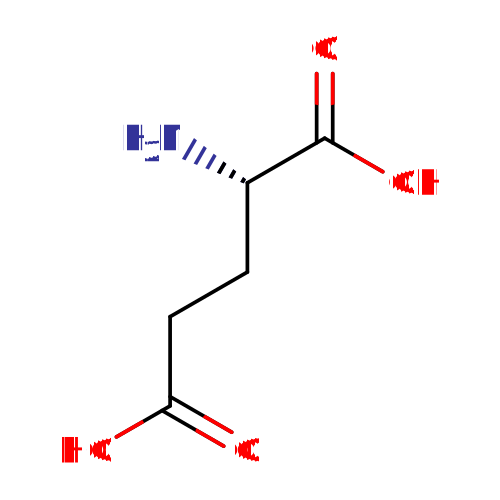
Structure for Glutamic acid (DB00142)
- Weight
- Average: 147.1293
Monoisotopic: 147.053157781 - Chemical Formula
- C5H9NO4
- Synonyms
- (2S)-2-Aminopentanedioic acid
- (S)-2-Aminopentanedioic acid
- (S)-Glutamic acid
- ácido glutámico
- Glu
- Glutamic acid
- L-Glutamate
- L-Glutamic acid
- L-Glutaminic acid
- External IDs
- E 620
- E-620
- FEMA NO. 3285
- INS NO.620
- INS-620
- NSC-143503

Pharmacology
- Indication
Considered to be nature's "Brain food" by improving mental capacities; helps speed the healing of ulcers; gives a "lift" from fatigue; helps control alcoholism, schizophrenia and the craving for sugar.
 Reduce drug development failure ratesBuild, train, & validate machine-learning modelswith evidence-based and structured datasets.Build, train, & validate predictive machine-learning models with structured datasets.
- Associated Therapies
- Contraindications & Blackbox Warnings
 Prevent Adverse Drug Events TodayTap into our Clinical API for life-saving information on contraindications & blackbox warnings, population restrictions, harmful risks, & more.Avoid life-threatening adverse drug events with our Clinical API
- Pharmacodynamics
In addition to being one of the building blocks in protein synthesis, it is the most widespread neurotransmitter in brain function, as an excitatory neurotransmitter and as a precursor for the synthesis of GABA in GABAergic neurons.
- Mechanism of action
Glutamate activates both ionotropic and metabotropic glutamate receptors. The ionotropic ones being non-NMDA (AMPA and kainate) and NMDA receptors. Free glutamic acid cannot cross the blood-brain barrier in appreciable quantities; instead it is converted into L-glutamine, which the brain uses for fuel and protein synthesis. It is conjectured that glutamate is involved in cognitive functions like learning and memory in the brain, though excessive amounts may cause neuronal damage associated in diseases like amyotrophic lateral sclerosis, lathyrism, and Alzheimer's disease. Also, the drug phencyclidine (more commonly known as PCP) antagonizes glutamate at the NMDA receptor, causing behavior reminiscent of schizophrenia. Glutamate in action is extremely difficult to study due to its transient nature.
- Absorption
Absorbed from the lumen of the small intestine into the enterocytes.Absorption is efficient and occurs by an active transport mechanism.
- Volume of distribution
Not Available
- Protein binding
Not Available
- Metabolism
Hepatic
- Route of elimination
Not Available
- Half-life
Not Available
- Clearance
Not Available
- Adverse Effects
 Improve decision support & research outcomesWith structured adverse effects data, including: blackbox warnings, adverse reactions, warning & precautions, & incidence rates. View sample adverse effects data in our new Data Library!Improve decision support & research outcomes with our structured adverse effects data.
- Toxicity
Glutamate causes neuronal damage and eventual cell death, particularly when NMDA receptors are activated, High dosages of glutamic acid may include symptoms such as headaches and neurological problems.
- Pathways
- Pharmacogenomic Effects/ADRs
- Not Available
Interactions
- Drug Interactions
- This information should not be interpreted without the help of a healthcare provider. If you believe you are experiencing an interaction, contact a healthcare provider immediately. The absence of an interaction does not necessarily mean no interactions exist.
Drug Interaction Integrate drug-drug
interactions in your softwareAmphetamine The serum concentration of Amphetamine can be decreased when it is combined with Glutamic acid. Benzphetamine The serum concentration of Benzphetamine can be decreased when it is combined with Glutamic acid. Dextroamphetamine The serum concentration of Dextroamphetamine can be decreased when it is combined with Glutamic acid. Diethylpropion The serum concentration of Diethylpropion can be decreased when it is combined with Glutamic acid. Iofetamine I-123 The serum concentration of Iofetamine I-123 can be decreased when it is combined with Glutamic acid. - Food Interactions
- No interactions found.
Products
 Drug product information from 10+ global regionsOur datasets provide approved product information including:dosage, form, labeller, route of administration, and marketing period.Access drug product information from over 10 global regions.
- Product Ingredients
Ingredient UNII CAS InChI Key Glutamic acid hydrochloride M0C2SP444T 138-15-8 RPAJSBKBKSSMLJ-DFWYDOINSA-N - Brand Name Prescription Products
Name Dosage Strength Route Labeller Marketing Start Marketing End Region Image Glutamic Acid HCl Cap 325mg Capsule 325 mg / cap Oral Stanley Pharmaceuticals, A Division Of Vita Health Products Inc. 1957-12-31 2002-07-31 Canada 
- Mixture Products
Name Ingredients Dosage Route Labeller Marketing Start Marketing End Region Image 20% Prosol Glutamic acid (1.02 g) + Alanine (2.76 g) + Arginine (1.96 g) + Aspartic acid (0.6 g) + D-Methionine (0.76 g) + Glycine (2.06 g) + Histidine (1.18 g) + Isoleucine (1.08 g) + Leucine (1.08 g) + Lysine (1.35 g) + Methionine (0.76 g) + Phenylalanine (1 g) + Proline (1.34 g) + Serine (1.02 g) + Threonine (0.98 g) + Tryptophan (0.32 g) + Tyrosine (0.05 g) + Valine (1.44 g) Liquid Intravenous Baxter Laboratories 1996-10-09 Not applicable Canada Aminoplasmal B. Braun 10% Solution for Intravenous Infusion Glutamic acid (7.2 g/1000ml) + Alanine (10.5 g/1000ml) + Arginine (11.5 g/1000ml) + Aspartic acid (5.6 g/1000ml) + Glycine (12 g/1000ml) + Histidine (3 g/1000ml) + Isoleucine (5 g/1000ml) + Leucine (8.9 g/1000ml) + Lysine acetate (5.74 g/1000ml) + Lysine monohydrate (3.12 g/1000ml) + Methionine (4.4 g/1000ml) + Phenylalanine (4.7 g/1000ml) + Proline (5.5 g/1000ml) + Serine (2.3 g/1000ml) + Threonine (4.2 g/1000ml) + Tryptophan (1.6 g/1000ml) + Tyrosine (0.4 g/1000ml) + Valine (6.2 g/1000ml) Injection, solution Intravenous B.BRAUN MEDICAL INDUSTRIES SDN BHD 2020-09-08 Not applicable Malaysia 
Aminoplasmal B. Braun 10%E Solution for Intravenous Infusion Glutamic acid (7.2 g/1000ml) + Alanine (10.5 g/1000ml) + Arginine (11.5 g/1000ml) + Aspartic acid (5.6 g/1000ml) + Glycine (12 g/1000ml) + Histidine (3 g/1000ml) + Isoleucine (5 g/1000ml) + Leucine (8.9 g/1000ml) + Lysine hydrochloride (8.56 g/1000ml) + Magnesium chloride hexahydrate (0.508 g/1000ml) + Methionine (4.4 g/1000ml) + Phenylalanine (4.7 g/1000ml) + Potassium acetate (2.453 g/1000ml) + Proline (5.5 g/1000ml) + Serine (2.3 g/1000ml) + Sodium acetate trihydrate (2.858 g/1000ml) + Sodium hydroxide (0.36 g/1000ml) + Sodium phosphate, dibasic dodecahydrate (3.581 g/1000ml) + Threonine (4.2 g/1000ml) + Tryptophan (1.6 g/1000ml) + Tyrosine (0.4 g/1000ml) + Valine (6.2 g/1000ml) Injection, solution Intravenous B.BRAUN MEDICAL INDUSTRIES SDN BHD 2020-09-08 Not applicable Malaysia Aminoplasmal B.Braun 10 % Infusionslösung Glutamic acid (3.6 g) + Alanine (5.25 g) + Arginine (5.75 g) + Aspartic acid (2.8 g) + Glycine (6 g) + Histidine (1.5 g) + Isoleucine (2.5 g) + Leucine (4.45 g) + Lysine acetate (5.74 g) + Lysine monohydrate (3.12 g) + Methionine (2.2 g) + Phenylalanine (2.35 g) + Proline (2.75 g) + Serine (1.15 g) + Threonine (2.1 g) + Tryptophan (0.8 g) + Tyrosine (0.2 g) + Valine (3.1 g) Solution Parenteral B. Braun Melsungen Ag 2006-06-27 Not applicable Austria 
AMINOPLASMAL B.BRAUN 10% E SOLUTION FOR INFUSION Glutamic acid (7.20 g/1000ml) + Alanine (10.50 g/1000ml) + Arginine (11.50 g/1000ml) + Aspartic acid (5.60 g/1000ml) + Glycine (12.00 g/1000ml) + Histidine (3.00 g/1000ml) + Isoleucine (5.00 g/1000ml) + Leucine (8.90 g/1000ml) + Lysine hydrochloride (8.56 g/1000ml) + Magnesium chloride hexahydrate (0.508 g/1000ml) + Methionine (4.40 g/1000ml) + Phenylalanine (4.70 g/1000ml) + Potassium acetate (2.453 g/1000ml) + Proline (5.50 g/1000ml) + Serine (2.30 g/1000ml) + Sodium acetate trihydrate (2.858 g/1000ml) + Sodium hydroxide (0.360 g/1000ml) + Sodium phosphate, dibasic dodecahydrate (3.581 g/1000ml) + Threonine (4.20 g/1000ml) + Tryptophan (1.60 g/1000ml) + Tyrosine (0.40 g/1000ml) + Valine (6.20 g/1000ml) Solution Intravenous B. BRAUN SINGAPORE PTE LTD 2018-01-23 Not applicable Singapore 
- Unapproved/Other Products
Name Ingredients Dosage Route Labeller Marketing Start Marketing End Region Image KABIVEN 1026 ML Glutamic acid (1.7 g) + Alanine (4.8 g) + Arginine (3.4 g) + Aspartic acid (1 g) + Calcium chloride dihydrate (0.29 g) + D-glucose monohydrate (110 g) + Glycine (2.4 g) + Histidine (2 g) + Isoleucine (1.7 g) + Leucine (2.4 g) + Lysine (2.7 g) + Magnesium sulfate heptahydrate (0.99 g) + Methionine (1.7 g) + Phenylalanine (2.4 g) + Potassium chloride (1.8 g) + Proline (2 g) + Serine (1.4 g) + Sodium acetate trihydrate (2.5 g) + Sodium glycerophosphate (1.5 g) + Soybean oil (40 g) + Threonine (1.7 g) + Tryptophan (0.57 g) + Tyrosine (0.07 g) + Valine (2.2 g) Injection Intravenous FRESENİUS KABİ İLAÇ SAN. VE TİC. LTD. ŞTİ. 2013-01-29 2022-11-10 Turkey 
KABIVEN 1540 ML Glutamic acid (2.5 g) + Alanine (7.2 g) + Arginine (5.1 g) + Aspartic acid (1.5 g) + Calcium chloride dihydrate (0.44 g) + D-glucose monohydrate (165 g) + Glycine (3.6 g) + Histidine (3.1 g) + Isoleucine (2.5 g) + Leucine (3.6 g) + Lysine (4.1 g) + Magnesium sulfate heptahydrate (1.5 g) + Methionine (2.5 g) + Phenylalanine (3.6 g) + Potassium chloride (2.7 g) + Proline (3.1 g) + Serine (2 g) + Sodium acetate trihydrate (3.7 g) + Sodium glycerophosphate (2.3 g) + Soybean oil (60 g) + Threonine (2.5 g) + Tryptophan (0.86 g) + Tyrosine (0.1 g) + Valine (3.3 g) Injection Intravenous FRESENİUS KABİ İLAÇ SAN. VE TİC. LTD. ŞTİ. 2013-01-29 2022-11-10 Turkey KABIVEN 2053 ML Glutamic acid (3.4 g) + Alanine (9.6 g) + Arginine (6.8 g) + Aspartic acid (2 g) + Calcium chloride dihydrate (0.59 g) + D-glucose monohydrate (220 g) + Glycine (4.7 g) + Histidine (4.1 g) + Isoleucine (3.4 g) + Leucine (4.7 g) + Lysine (5.4 g) + Magnesium sulfate heptahydrate (2 g) + Methionine (3.4 g) + Phenylalanine (4.7 g) + Potassium chloride (3.6 g) + Proline (4.1 g) + Serine (2.7 g) + Sodium acetate trihydrate (4.9 g) + Sodium glycerophosphate (3 g) + Soybean oil (80 g) + Threonine (3.4 g) + Tryptophan (1.1 g) + Tyrosine (0.14 g) + Valine (4.4 g) Injection Intravenous FRESENİUS KABİ İLAÇ SAN. VE TİC. LTD. ŞTİ. 2013-01-29 2022-11-10 Turkey KABIVEN PERIPHERAL 1440 ML Glutamic acid (1.7 g) + Alanine (4.8 g) + Arginine (3.4 g) + Aspartic acid (1 g) + Calcium chloride dihydrate (0.29 g) + D-glucose monohydrate (107 g) + Glycine (2.4 g) + Histidine (2 g) + Isoleucine (1.7 g) + Leucine (2.4 g) + Lysine (2.7 g) + Magnesium sulfate heptahydrate (0.99 g) + Methionine (1.7 g) + Phenylalanine (2.4 g) + Potassium chloride (1.8 g) + Proline (2 g) + Serine (1.4 g) + Sodium acetate trihydrate (2.5 g) + Sodium glycerophosphate (1.5 g) + Soybean oil (51 g) + Threonine (1.7 g) + Tryptophan (0.57 g) + Tyrosine (0.069 g) + Valine (2.2 g) Injection Intravenous FRESENİUS KABİ İLAÇ SAN. VE TİC. LTD. ŞTİ. 2013-01-29 2024-03-28 Turkey KABIVEN PERIPHERAL 1920 ML Glutamic acid (2.2 g) + Alanine (6.4 g) + Arginine (4.5 g) + Aspartic acid (1.4 g) + Calcium chloride dihydrate (0.39 g) + D-glucose monohydrate (143 g) + Glycine (3.2 g) + Histidine (2.7 g) + Isoleucine (2.2 g) + Leucine (3.2 g) + Lysine (3.6 g) + Magnesium sulfate heptahydrate (1.3 g) + Methionine (2.2 g) + Phenylalanine (3.2 g) + Potassium chloride (2.4 g) + Proline (2.7 g) + Serine (1.8 g) + Sodium acetate trihydrate (3.3 g) + Sodium glycerophosphate (2 g) + Soybean oil (68 g) + Threonine (2.2 g) + Tryptophan (0.76 g) + Tyrosine (0.092 g) + Valine (2.9 g) Injection Intravenous FRESENİUS KABİ İLAÇ SAN. VE TİC. LTD. ŞTİ. 2013-01-29 2024-03-28 Turkey
Categories
- ATC Codes
- A09AB01 — Glutamic acid hydrochloride
- Drug Categories
- Acid Preparations
- Alimentary Tract and Metabolism
- Amino Acids
- Amino Acids, Acidic
- Amino Acids, Dicarboxylic
- Amino Acids, Peptides, and Proteins
- Dietary Supplements
- Digestives, Incl. Enzymes
- Excitatory Amino Acids
- Gastrointestinal Acidifying Agents
- Gastrointestinal Agents
- Glutamates
- Proteinogenic Amino Acids
- Supplements
- Chemical TaxonomyProvided by Classyfire
- Description
- This compound belongs to the class of organic compounds known as glutamic acid and derivatives. These are compounds containing glutamic acid or a derivative thereof resulting from reaction of glutamic acid at the amino group or the carboxy group, or from the replacement of any hydrogen of glycine by a heteroatom.
- Kingdom
- Organic compounds
- Super Class
- Organic acids and derivatives
- Class
- Carboxylic acids and derivatives
- Sub Class
- Amino acids, peptides, and analogues
- Direct Parent
- Glutamic acid and derivatives
- Alternative Parents
- L-alpha-amino acids / Amino fatty acids / Dicarboxylic acids and derivatives / Amino acids / Carboxylic acids / Organopnictogen compounds / Organic oxides / Monoalkylamines / Hydrocarbon derivatives / Carbonyl compounds
- Substituents
- Aliphatic acyclic compound / Alpha-amino acid / Amine / Amino acid / Amino fatty acid / Carbonyl group / Carboxylic acid / Dicarboxylic acid or derivatives / Fatty acid / Fatty acyl
- Molecular Framework
- Aliphatic acyclic compounds
- External Descriptors
- proteinogenic amino acid, L-alpha-amino acid, glutamic acid, glutamine family amino acid (CHEBI:16015) / Common amino acids, Amino acids (C00025)
- Affected organisms
- Humans and other mammals
Chemical Identifiers
- UNII
- 3KX376GY7L
- CAS number
- 56-86-0
- InChI Key
- WHUUTDBJXJRKMK-VKHMYHEASA-N
- InChI
- InChI=1S/C5H9NO4/c6-3(5(9)10)1-2-4(7)8/h3H,1-2,6H2,(H,7,8)(H,9,10)/t3-/m0/s1
- IUPAC Name
- (2S)-2-aminopentanedioic acid
- SMILES
- N[C@@H](CCC(O)=O)C(O)=O
References
- Synthesis Reference
Nobuharu Tujimoto, Yoshimi Kikuchi, Osamu Kurahashi, Yoshiko Kawahara, "Mutant Escherichia coli capable of enhanced L-glutamic acid production." U.S. Patent US5393671, issued August, 1960.
US5393671- General References
- Smith QR: Transport of glutamate and other amino acids at the blood-brain barrier. J Nutr. 2000 Apr;130(4S Suppl):1016S-22S. [Article]
- Okumoto S, Looger LL, Micheva KD, Reimer RJ, Smith SJ, Frommer WB: Detection of glutamate release from neurons by genetically encoded surface-displayed FRET nanosensors. Proc Natl Acad Sci U S A. 2005 Jun 14;102(24):8740-5. Epub 2005 Jun 6. [Article]
- Reeds PJ, Burrin DG, Stoll B, Jahoor F: Intestinal glutamate metabolism. J Nutr. 2000 Apr;130(4S Suppl):978S-82S. [Article]
- Corrie JE, DeSantis A, Katayama Y, Khodakhah K, Messenger JB, Ogden DC, Trentham DR: Postsynaptic activation at the squid giant synapse by photolytic release of L-glutamate from a 'caged' L-glutamate. J Physiol. 1993 Jun;465:1-8. [Article]
- Augustin H, Grosjean Y, Chen K, Sheng Q, Featherstone DE: Nonvesicular release of glutamate by glial xCT transporters suppresses glutamate receptor clustering in vivo. J Neurosci. 2007 Jan 3;27(1):111-23. [Article]
- Sookoian S, Pirola CJ: Alanine and aspartate aminotransferase and glutamine-cycling pathway: their roles in pathogenesis of metabolic syndrome. World J Gastroenterol. 2012 Aug 7;18(29):3775-81. doi: 10.3748/wjg.v18.i29.3775. [Article]
- External Links
- Human Metabolome Database
- HMDB0000148
- KEGG Drug
- D00007
- KEGG Compound
- C00025
- PubChem Compound
- 33032
- PubChem Substance
- 46505816
- ChemSpider
- 30572
- BindingDB
- 17657
- 25916
- ChEBI
- 16015
- ChEMBL
- CHEMBL575060
- ZINC
- ZINC000001482113
- Therapeutic Targets Database
- DAP000015
- PharmGKB
- PA449776
- Guide to Pharmacology
- GtP Drug Page
- PDBe Ligand
- GGL
- Wikipedia
- Glutamic_acid
- PDB Entries
- 1axd / 1bx9 / 1fav / 2dbw / 2m5p / 2m5q / 3ths / 5bpu / 5onj / 7f5x … show 19 more
- MSDS
- Download (72 KB)
Clinical Trials
- Clinical Trials
Pharmacoeconomics
- Manufacturers
- Not Available
- Packagers
- Amend
- Dosage Forms
Form Route Strength Solution Parenteral Solution Intravenous 10.50 g/1000ml Injection Intravenous 0.5 g/l Injection Intravenous 0.25 g/1000ml Solution, concentrate Intravenous Injection, solution Intravenous Solution Extracorporeal Emulsion Intravenous 0.468 g Injection Intravenous 16 g/1000ml Capsule Oral 325 mg / cap Emulsion Parenteral 20.000 g Injection Intravenous 1.6 g/l Tablet Oral Injection, solution, concentrate Intravenous Injection, emulsion Parenteral Emulsion Intravenous 0.466 g Emulsion Parenteral Emulsion Intravenous Injection, solution Injection, emulsion Intravenous 4.656 g/1000ml Injection, emulsion Intravenous 6.792 g/1000ml Injection, emulsion Intravenous Emulsion Intravenous 4 g Tablet, film coated Oral Emulsion Intravenous 3 g Solution Intravenous Injection Intravenous Injection Intravenous 4 g/l Liquid Intravenous Granule Capsule Oral Gel Topical - Prices
Unit description Cost Unit L-glutamic acid powder 0.03USD g DrugBank does not sell nor buy drugs. Pricing information is supplied for informational purposes only.- Patents
- Not Available
Properties
- State
- Solid
- Experimental Properties
Property Value Source melting point (°C) 224 dec °C PhysProp water solubility 8570 mg/L (at 25 °C) BULL,HB ET AL. (1978) logP -3.69 HANSCH,C ET AL. (1995) pKa 2.23 (at 0 °C) KORTUM,G ET AL (1961) - Predicted Properties
Property Value Source Water Solubility 80.6 mg/mL ALOGPS logP -3.5 ALOGPS logP -3.2 Chemaxon logS -0.26 ALOGPS pKa (Strongest Acidic) 1.88 Chemaxon pKa (Strongest Basic) 9.54 Chemaxon Physiological Charge -1 Chemaxon Hydrogen Acceptor Count 5 Chemaxon Hydrogen Donor Count 3 Chemaxon Polar Surface Area 100.62 Å2 Chemaxon Rotatable Bond Count 4 Chemaxon Refractivity 31.29 m3·mol-1 Chemaxon Polarizability 13.32 Å3 Chemaxon Number of Rings 0 Chemaxon Bioavailability 1 Chemaxon Rule of Five Yes Chemaxon Ghose Filter No Chemaxon Veber's Rule No Chemaxon MDDR-like Rule No Chemaxon - Predicted ADMET Features
- Not Available
Spectra
- Mass Spec (NIST)
- Download (8.03 KB)
- Spectra
- Chromatographic Properties
Collision Cross Sections (CCS)
Adduct CCS Value (Å2) Source type Source [M-H]- 131.8644365 predictedDarkChem Lite v0.1.0 [M-H]- 124.4646298 predictedDarkChem Standard v0.1.0 [M-H]- 132.1397365 predictedDarkChem Lite v0.1.0 [M-H]- 123.92267 predictedDeepCCS 1.0 (2019) [M+H]+ 132.2015365 predictedDarkChem Lite v0.1.0 [M+H]+ 132.3227365 predictedDarkChem Lite v0.1.0 [M+H]+ 131.5411365 predictedDarkChem Lite v0.1.0 [M+H]+ 127.75757 predictedDeepCCS 1.0 (2019) [M+Na]+ 131.8403365 predictedDarkChem Lite v0.1.0 [M+Na]+ 131.7180365 predictedDarkChem Lite v0.1.0 [M+Na]+ 132.3460365 predictedDarkChem Lite v0.1.0 [M+Na]+ 136.84706 predictedDeepCCS 1.0 (2019)
Targets

- Kind
- Protein
- Organism
- Humans
- Pharmacological action
- Unknown
- General Function
- Glutamate receptor activity
- Specific Function
- G-protein coupled receptor for glutamate. Ligand binding causes a conformation change that triggers signaling via guanine nucleotide-binding proteins (G proteins) and modulates the activity of down...
- Gene Name
- GRM1
- Uniprot ID
- Q13255
- Uniprot Name
- Metabotropic glutamate receptor 1
- Molecular Weight
- 132355.855 Da
References
- Suzuki G, Kimura T, Satow A, Kaneko N, Fukuda J, Hikichi H, Sakai N, Maehara S, Kawagoe-Takaki H, Hata M, Azuma T, Ito S, Kawamoto H, Ohta H: Pharmacological characterization of a new, orally active and potent allosteric metabotropic glutamate receptor 1 antagonist, 4-[1-(2-fluoropyridin-3-yl)-5-methyl-1H-1,2,3-triazol-4-yl]-N-isopropyl-N-methyl- 3,6-dihydropyridine-1(2H)-carboxamide (FTIDC). J Pharmacol Exp Ther. 2007 Jun;321(3):1144-53. Epub 2007 Mar 14. [Article]
- Chiocchetti A, Miglio G, Mesturini R, Varsaldi F, Mocellin M, Orilieri E, Dianzani C, Fantozzi R, Dianzani U, Lombardi G: Group I mGlu receptor stimulation inhibits activation-induced cell death of human T lymphocytes. Br J Pharmacol. 2006 Jul;148(6):760-8. Epub 2006 Jun 5. [Article]
- San Gabriel AM, Maekawa T, Uneyama H, Yoshie S, Torii K: mGluR1 in the fundic glands of rat stomach. FEBS Lett. 2007 Mar 20;581(6):1119-23. Epub 2007 Feb 22. [Article]
- Kind
- Protein
- Organism
- Humans
- Pharmacological action
- Unknown
- General Function
- Group iii metabotropic glutamate receptor activity
- Specific Function
- G-protein coupled receptor for glutamate. Ligand binding causes a conformation change that triggers signaling via guanine nucleotide-binding proteins (G proteins) and modulates the activity of down...
- Gene Name
- GRM4
- Uniprot ID
- Q14833
- Uniprot Name
- Metabotropic glutamate receptor 4
- Molecular Weight
- 101866.835 Da
References
- Suzuki G, Kimura T, Satow A, Kaneko N, Fukuda J, Hikichi H, Sakai N, Maehara S, Kawagoe-Takaki H, Hata M, Azuma T, Ito S, Kawamoto H, Ohta H: Pharmacological characterization of a new, orally active and potent allosteric metabotropic glutamate receptor 1 antagonist, 4-[1-(2-fluoropyridin-3-yl)-5-methyl-1H-1,2,3-triazol-4-yl]-N-isopropyl-N-methyl- 3,6-dihydropyridine-1(2H)-carboxamide (FTIDC). J Pharmacol Exp Ther. 2007 Jun;321(3):1144-53. Epub 2007 Mar 14. [Article]
- Kind
- Protein
- Organism
- Humans
- Pharmacological action
- Unknown
- General Function
- Kainate selective glutamate receptor activity
- Specific Function
- Receptor for glutamate. L-glutamate acts as an excitatory neurotransmitter at many synapses in the central nervous system. The postsynaptic actions of Glu are mediated by a variety of receptors tha...
- Gene Name
- GRIK4
- Uniprot ID
- Q16099
- Uniprot Name
- Glutamate receptor ionotropic, kainate 4
- Molecular Weight
- 107244.485 Da
References
- Overington JP, Al-Lazikani B, Hopkins AL: How many drug targets are there? Nat Rev Drug Discov. 2006 Dec;5(12):993-6. [Article]
- Imming P, Sinning C, Meyer A: Drugs, their targets and the nature and number of drug targets. Nat Rev Drug Discov. 2006 Oct;5(10):821-34. [Article]
- Korczak B, Nutt SL, Fletcher EJ, Hoo KH, Elliott CE, Rampersad V, McWhinnie EA, Kamboj RK: cDNA cloning and functional properties of human glutamate receptor EAA3 (GluR5) in homomeric and heteromeric configuration. Receptors Channels. 1995;3(1):41-9. [Article]
- Kind
- Protein
- Organism
- Humans
- Pharmacological action
- Unknown
- General Function
- Kainate selective glutamate receptor activity
- Specific Function
- Receptor for glutamate. L-glutamate acts as an excitatory neurotransmitter at many synapses in the central nervous system. The postsynaptic actions of Glu are mediated by a variety of receptors tha...
- Gene Name
- GRIK5
- Uniprot ID
- Q16478
- Uniprot Name
- Glutamate receptor ionotropic, kainate 5
- Molecular Weight
- 109263.695 Da
References
- Overington JP, Al-Lazikani B, Hopkins AL: How many drug targets are there? Nat Rev Drug Discov. 2006 Dec;5(12):993-6. [Article]
- Imming P, Sinning C, Meyer A: Drugs, their targets and the nature and number of drug targets. Nat Rev Drug Discov. 2006 Oct;5(10):821-34. [Article]
- Takeda M, Haga M, Yamada H, Kinoshita M, Otsuka M, Tsuboi S, Moriyama Y: Ionotropic glutamate receptors expressed in human retinoblastoma Y79 cells. Neurosci Lett. 2000 Nov 17;294(2):97-100. [Article]
- Murphy DE, Hutchison AJ, Hurt SD, Williams M, Sills MA: Characterization of the binding of [3H]-CGS 19755: a novel N-methyl-D-aspartate antagonist with nanomolar affinity in rat brain. Br J Pharmacol. 1988 Nov;95(3):932-8. [Article]
- Kind
- Protein
- Organism
- Humans
- Pharmacological action
- Unknown
- General Function
- Voltage-gated calcium channel activity
- Specific Function
- G-protein coupled receptor for glutamate. Ligand binding causes a conformation change that triggers signaling via guanine nucleotide-binding proteins (G proteins) and modulates the activity of down...
- Gene Name
- GRM7
- Uniprot ID
- Q14831
- Uniprot Name
- Metabotropic glutamate receptor 7
- Molecular Weight
- 102250.06 Da
References
- Suzuki G, Kimura T, Satow A, Kaneko N, Fukuda J, Hikichi H, Sakai N, Maehara S, Kawagoe-Takaki H, Hata M, Azuma T, Ito S, Kawamoto H, Ohta H: Pharmacological characterization of a new, orally active and potent allosteric metabotropic glutamate receptor 1 antagonist, 4-[1-(2-fluoropyridin-3-yl)-5-methyl-1H-1,2,3-triazol-4-yl]-N-isopropyl-N-methyl- 3,6-dihydropyridine-1(2H)-carboxamide (FTIDC). J Pharmacol Exp Ther. 2007 Jun;321(3):1144-53. Epub 2007 Mar 14. [Article]
- Kind
- Protein
- Organism
- Humans
- Pharmacological action
- Unknown
- General Function
- Group iii metabotropic glutamate receptor activity
- Specific Function
- G-protein coupled receptor for glutamate. Ligand binding causes a conformation change that triggers signaling via guanine nucleotide-binding proteins (G proteins) and modulates the activity of down...
- Gene Name
- GRM8
- Uniprot ID
- O00222
- Uniprot Name
- Metabotropic glutamate receptor 8
- Molecular Weight
- 101739.575 Da
References
- Suzuki G, Kimura T, Satow A, Kaneko N, Fukuda J, Hikichi H, Sakai N, Maehara S, Kawagoe-Takaki H, Hata M, Azuma T, Ito S, Kawamoto H, Ohta H: Pharmacological characterization of a new, orally active and potent allosteric metabotropic glutamate receptor 1 antagonist, 4-[1-(2-fluoropyridin-3-yl)-5-methyl-1H-1,2,3-triazol-4-yl]-N-isopropyl-N-methyl- 3,6-dihydropyridine-1(2H)-carboxamide (FTIDC). J Pharmacol Exp Ther. 2007 Jun;321(3):1144-53. Epub 2007 Mar 14. [Article]
- Morimoto R, Uehara S, Yatsushiro S, Juge N, Hua Z, Senoh S, Echigo N, Hayashi M, Mizoguchi T, Ninomiya T, Udagawa N, Omote H, Yamamoto A, Edwards RH, Moriyama Y: Secretion of L-glutamate from osteoclasts through transcytosis. EMBO J. 2006 Sep 20;25(18):4175-86. Epub 2006 Sep 7. [Article]
- Kind
- Protein
- Organism
- Humans
- Pharmacological action
- Unknown
- General Function
- Sodium:dicarboxylate symporter activity
- Specific Function
- Transports L-glutamate; the L-glutamate uptake is sodium- and voltage-dependent and chloride-independent. Its associated chloride conductance may participate in visual processing.
- Gene Name
- SLC1A7
- Uniprot ID
- O00341
- Uniprot Name
- Excitatory amino acid transporter 5
- Molecular Weight
- 60657.825 Da
References
- Overington JP, Al-Lazikani B, Hopkins AL: How many drug targets are there? Nat Rev Drug Discov. 2006 Dec;5(12):993-6. [Article]
- Imming P, Sinning C, Meyer A: Drugs, their targets and the nature and number of drug targets. Nat Rev Drug Discov. 2006 Oct;5(10):821-34. [Article]
- Takarada T, Hinoi E, Balcar VJ, Taniura H, Yoneda Y: Possible expression of functional glutamate transporters in the rat testis. J Endocrinol. 2004 May;181(2):233-44. [Article]
- Arriza JL, Eliasof S, Kavanaugh MP, Amara SG: Excitatory amino acid transporter 5, a retinal glutamate transporter coupled to a chloride conductance. Proc Natl Acad Sci U S A. 1997 Apr 15;94(8):4155-60. [Article]
- Kind
- Protein
- Organism
- Humans
- Pharmacological action
- Unknown
- General Function
- Atp binding
- Specific Function
- Catalyzes the cleavage of 5-oxo-L-proline to form L-glutamate coupled to the hydrolysis of ATP to ADP and inorganic phosphate.
- Gene Name
- OPLAH
- Uniprot ID
- O14841
- Uniprot Name
- 5-oxoprolinase
- Molecular Weight
- 137456.195 Da
References
- Overington JP, Al-Lazikani B, Hopkins AL: How many drug targets are there? Nat Rev Drug Discov. 2006 Dec;5(12):993-6. [Article]
- Imming P, Sinning C, Meyer A: Drugs, their targets and the nature and number of drug targets. Nat Rev Drug Discov. 2006 Oct;5(10):821-34. [Article]
- Nishimura A, Itoh H, Oyama H, Murao S, Oda K: A simultaneous assay method for L-glutamate and L-pyroglutamate contents in soy sauce using a 5-oxoprolinase (without ATP hydrolyzing activity). Biosci Biotechnol Biochem. 2001 Feb;65(2):477-9. [Article]
- Van der Werf P, Stephani RA, Orlowski M, Meister A: Inhibition of 5-oxoprolinase by 2-imidazolidone-4-carboxylic acid. Proc Natl Acad Sci U S A. 1973 Mar;70(3):759-61. [Article]
- Seddon AP, Li LY, Meister A: Resolution of 5-oxo-L-prolinase into a 5-oxo-L-proline-dependent ATPase and a coupling protein. J Biol Chem. 1984 Jul 10;259(13):8091-4. [Article]
- Kind
- Protein
- Organism
- Humans
- Pharmacological action
- Unknown
- General Function
- Phosphoribosylformylglycinamidine synthase activity
- Specific Function
- Phosphoribosylformylglycinamidine synthase involved in the purines biosynthetic pathway. Catalyzes the ATP-dependent conversion of formylglycinamide ribonucleotide (FGAR) and glutamine to yield for...
- Gene Name
- PFAS
- Uniprot ID
- O15067
- Uniprot Name
- Phosphoribosylformylglycinamidine synthase
- Molecular Weight
- 144733.165 Da
References
- Overington JP, Al-Lazikani B, Hopkins AL: How many drug targets are there? Nat Rev Drug Discov. 2006 Dec;5(12):993-6. [Article]
- Imming P, Sinning C, Meyer A: Drugs, their targets and the nature and number of drug targets. Nat Rev Drug Discov. 2006 Oct;5(10):821-34. [Article]
- Jayaram HN, Lui MS, Plowman J, Pillwein K, Reardon MA, Elliott WL, Weber G: Oncolytic activity and mechanism of action of a novel L-cysteine derivative, L-cysteine, ethyl ester, S-(N-methylcarbamate) monohydrochloride. Cancer Chemother Pharmacol. 1990;26(2):88-92. [Article]
- Kind
- Protein
- Organism
- Humans
- Pharmacological action
- Unknown
- General Function
- L-valine transaminase activity
- Specific Function
- Catalyzes the first reaction in the catabolism of the essential branched chain amino acids leucine, isoleucine, and valine. May also function as a transporter of branched chain alpha-keto acids.
- Gene Name
- BCAT2
- Uniprot ID
- O15382
- Uniprot Name
- Branched-chain-amino-acid aminotransferase, mitochondrial
- Molecular Weight
- 44287.445 Da
References
- Hutson SM, Berkich D, Drown P, Xu B, Aschner M, LaNoue KF: Role of branched-chain aminotransferase isoenzymes and gabapentin in neurotransmitter metabolism. J Neurochem. 1998 Aug;71(2):863-74. doi: 10.1046/j.1471-4159.1998.71020863.x. [Article]
- Ola MS, Hosoya K, LaNoue KF: Influence of insulin on glutamine synthetase in the Muller glial cells of retina. Metab Brain Dis. 2011 Sep;26(3):195-202. doi: 10.1007/s11011-011-9245-y. Epub 2011 May 31. [Article]
- Kind
- Protein
- Organism
- Humans
- Pharmacological action
- Unknown
- General Function
- Nmda glutamate receptor activity
- Specific Function
- NMDA receptor subtype of glutamate-gated ion channels with high calcium permeability and voltage-dependent sensitivity to magnesium. Mediated by glycine.
- Gene Name
- GRIN2D
- Uniprot ID
- O15399
- Uniprot Name
- Glutamate receptor ionotropic, NMDA 2D
- Molecular Weight
- 143750.685 Da
References
- Overington JP, Al-Lazikani B, Hopkins AL: How many drug targets are there? Nat Rev Drug Discov. 2006 Dec;5(12):993-6. [Article]
- Imming P, Sinning C, Meyer A: Drugs, their targets and the nature and number of drug targets. Nat Rev Drug Discov. 2006 Oct;5(10):821-34. [Article]
- Pliss L, Jezova D, Mares V, Balcar VJ, St'astny F: N-Acetyl-L-aspartyl-L-glutamate changes functional and structural properties of rat blood-brain barrier. Neurosci Lett. 2002 Jan 11;317(2):85-8. [Article]
- Bresink I, Benke TA, Collett VJ, Seal AJ, Parsons CG, Henley JM, Collingridge GL: Effects of memantine on recombinant rat NMDA receptors expressed in HEK 293 cells. Br J Pharmacol. 1996 Sep;119(2):195-204. [Article]
- Sundstrom E, Whittemore S, Mo LL, Seiger A: Analysis of NMDA receptors in the human spinal cord. Exp Neurol. 1997 Dec;148(2):407-13. [Article]
- Kind
- Protein
- Organism
- Humans
- Pharmacological action
- Unknown
- General Function
- Glutaminase activity
- Specific Function
- Catalyzes the first reaction in the primary pathway for the renal catabolism of glutamine. Plays a role in maintaining acid-base homeostasis. Regulates the levels of the neurotransmitter glutamate ...
- Gene Name
- GLS
- Uniprot ID
- O94925
- Uniprot Name
- Glutaminase kidney isoform, mitochondrial
- Molecular Weight
- 73460.56 Da
References
- Karmaker S, Saha TK, Yoshikawa Y, Yasui H, Sakurai H: A novel drug delivery system for type 1 diabetes: insulin-mimetic vanadyl-poly(gamma-glutamic acid) complex. J Inorg Biochem. 2006 Sep;100(9):1535-46. Epub 2006 May 24. [Article]
- Shi F, Xu Z, Cen P: Efficient production of poly-gamma-glutamic acid by Bacillus subtilis ZJU-7. Appl Biochem Biotechnol. 2006 Jun;133(3):271-82. [Article]
- Yang XX, Hu ZP, Xu AL, Duan W, Zhu YZ, Huang M, Sheu FS, Zhang Q, Bian JS, Chan E, Li X, Wang JC, Zhou SF: A mechanistic study on reduced toxicity of irinotecan by coadministered thalidomide, a tumor necrosis factor-alpha inhibitor. J Pharmacol Exp Ther. 2006 Oct;319(1):82-104. Epub 2006 Jun 30. [Article]
- Ashiuchi M, Shimanouchi K, Horiuchi T, Kamei T, Misono H: Genetically engineered poly-gamma-glutamate producer from Bacillus subtilis ISW1214. Biosci Biotechnol Biochem. 2006 Jul;70(7):1794-7. [Article]
- Ashiuchi M, Nakamura H, Yamamoto M, Misono H: Novel poly-gamma-glutamate-processing enzyme catalyzing gamma-glutamyl DD-amidohydrolysis. J Biosci Bioeng. 2006 Jul;102(1):60-5. [Article]
- Kind
- Protein
- Organism
- Humans
- Pharmacological action
- Unknown
- General Function
- Pyridoxal phosphate binding
- Specific Function
- Catalyzes the irreversible transamination of the L-tryptophan metabolite L-kynurenine to form kynurenic acid (KA). Plays a key role in amino acid metabolism. Important for metabolite exchange betwe...
- Gene Name
- GOT2
- Uniprot ID
- P00505
- Uniprot Name
- Aspartate aminotransferase, mitochondrial
- Molecular Weight
- 47517.285 Da
References
- Overington JP, Al-Lazikani B, Hopkins AL: How many drug targets are there? Nat Rev Drug Discov. 2006 Dec;5(12):993-6. [Article]
- Imming P, Sinning C, Meyer A: Drugs, their targets and the nature and number of drug targets. Nat Rev Drug Discov. 2006 Oct;5(10):821-34. [Article]
- Recasens M, Mandel P: Similarities between cysteinesulphinate transaminase and aspartate aminotransferase. Ciba Found Symp. 1979;(72):259-70. [Article]
- Berman HM, Westbrook J, Feng Z, Gilliland G, Bhat TN, Weissig H, Shindyalov IN, Bourne PE: The Protein Data Bank. Nucleic Acids Res. 2000 Jan 1;28(1):235-42. [Article]
- Kind
- Protein
- Organism
- Humans
- Pharmacological action
- Unknown
- General Function
- Rna stem-loop binding
- Specific Function
- Catalyzes the attachment of the cognate amino acid to the corresponding tRNA in a two-step reaction: the amino acid is first activated by ATP to form a covalent intermediate with AMP and is then tr...
- Gene Name
- EPRS
- Uniprot ID
- P07814
- Uniprot Name
- Bifunctional glutamate/proline--tRNA ligase
- Molecular Weight
- 170589.705 Da
References
- Overington JP, Al-Lazikani B, Hopkins AL: How many drug targets are there? Nat Rev Drug Discov. 2006 Dec;5(12):993-6. [Article]
- Imming P, Sinning C, Meyer A: Drugs, their targets and the nature and number of drug targets. Nat Rev Drug Discov. 2006 Oct;5(10):821-34. [Article]
- Cerini C, Semeriva M, Gratecos D: Evolution of the aminoacyl-tRNA synthetase family and the organization of the Drosophila glutamyl-prolyl-tRNA synthetase gene. Intron/exon structure of the gene, control of expression of the two mRNAs, selective advantage of the multienzyme complex. Eur J Biochem. 1997 Feb 15;244(1):176-85. [Article]
- Ting SM, Dignam JD: Post-transcriptional regulation of glutamyl-prolyl-tRNA synthetase in rat salivary gland. J Biol Chem. 1994 Mar 25;269(12):8993-8. [Article]
- Kind
- Protein
- Organism
- Humans
- Pharmacological action
- Unknown
- Curator comments
- Literature referenced did research on proteins from E. coli.
- General Function
- Protein homodimerization activity
- Specific Function
- Not Available
- Gene Name
- ASNS
- Uniprot ID
- P08243
- Uniprot Name
- Asparagine synthetase [glutamine-hydrolyzing]
- Molecular Weight
- 64369.39 Da
References
- Boehlein SK, Schuster SM, Richards NG: Glutamic acid gamma-monohydroxamate and hydroxylamine are alternate substrates for Escherichia coli asparagine synthetase B. Biochemistry. 1996 Mar 5;35(9):3031-7. doi: 10.1021/bi952505l. [Article]
- Kind
- Protein
- Organism
- Humans
- Pharmacological action
- Unknown
- General Function
- Manganese ion binding
- Specific Function
- This enzyme has 2 functions: it catalyzes the production of glutamine and 4-aminobutanoate (gamma-aminobutyric acid, GABA), the latter in a pyridoxal phosphate-independent manner (By similarity). E...
- Gene Name
- GLUL
- Uniprot ID
- P15104
- Uniprot Name
- Glutamine synthetase
- Molecular Weight
- 42064.15 Da
References
- Re DB, Nafia I, Melon C, Shimamoto K, Kerkerian-Le Goff L, Had-Aissouni L: Glutamate leakage from a compartmentalized intracellular metabolic pool and activation of the lipoxygenase pathway mediate oxidative astrocyte death by reversed glutamate transport. Glia. 2006 Jul;54(1):47-57. [Article]
- Singh U, Sarkar D: Development of a simple high-throughput screening protocol based on biosynthetic activity of Mycobacterium tuberculosis glutamine synthetase for the identification of novel Inhibitors. J Biomol Screen. 2006 Dec;11(8):1035-42. Epub 2006 Sep 14. [Article]
- Yamamoto S, Wakayama M, Tachiki T: Characterization of theanine-forming enzyme from Methylovorus mays no. 9 in respect to utilization of theanine production. Biosci Biotechnol Biochem. 2007 Feb;71(2):545-52. Epub 2007 Feb 7. [Article]
- Scaraffia PY, Zhang Q, Wysocki VH, Isoe J, Wells MA: Analysis of whole body ammonia metabolism in Aedes aegypti using [15N]-labeled compounds and mass spectrometry. Insect Biochem Mol Biol. 2006 Aug;36(8):614-22. Epub 2006 May 19. [Article]
- Kind
- Protein
- Organism
- Humans
- Pharmacological action
- Unknown
- General Function
- Pyridoxal phosphate binding
- Specific Function
- Biosynthesis of L-glutamate from L-aspartate or L-cysteine. Important regulator of levels of glutamate, the major excitatory neurotransmitter of the vertebrate central nervous system. Acts as a sca...
- Gene Name
- GOT1
- Uniprot ID
- P17174
- Uniprot Name
- Aspartate aminotransferase, cytoplasmic
- Molecular Weight
- 46247.14 Da
References
- Yudkoff M, Daikhin Y, Melo TM, Nissim I, Sonnewald U, Nissim I: The ketogenic diet and brain metabolism of amino acids: relationship to the anticonvulsant effect. Annu Rev Nutr. 2007;27:415-30. [Article]
- Kind
- Protein
- Organism
- Humans
- Pharmacological action
- Unknown
- General Function
- Pyridoxal phosphate binding
- Specific Function
- Transaminase involved in tyrosine breakdown. Converts tyrosine to p-hydroxyphenylpyruvate. Can catalyze the reverse reaction, using glutamic acid, with 2-oxoglutarate as cosubstrate (in vitro). Has...
- Gene Name
- TAT
- Uniprot ID
- P17735
- Uniprot Name
- Tyrosine aminotransferase
- Molecular Weight
- 50398.895 Da
References
- Ozturk M, Chiu CY, Akdeniz N, Jenq SF, Chang SC, Hsa CY, Jap TS: Two novel mutations in the MEN1 gene in subjects with multiple endocrine neoplasia-1. J Endocrinol Invest. 2006 Jun;29(6):523-7. [Article]
- Kind
- Protein
- Organism
- Humans
- Pharmacological action
- Unknown
- General Function
- Pyridoxal phosphate binding
- Specific Function
- Catalyzes the reversible transamination between alanine and 2-oxoglutarate to form pyruvate and glutamate. Participates in cellular nitrogen metabolism and also in liver gluconeogenesis starting wi...
- Gene Name
- GPT
- Uniprot ID
- P24298
- Uniprot Name
- Alanine aminotransferase 1
- Molecular Weight
- 54636.415 Da
References
- Ohgami N, Upadhyay S, Kabata A, Morimoto K, Kusakabe H, Suzuki H: Determination of the activities of glutamic oxaloacetic transaminase and glutamic pyruvic transaminase in a microfluidic system. Biosens Bioelectron. 2007 Feb 15;22(7):1330-6. Epub 2006 Jul 18. [Article]
- Kind
- Protein
- Organism
- Humans
- Pharmacological action
- Unknown
- General Function
- Gamma-glutamyl carboxylase activity
- Specific Function
- Mediates the vitamin K-dependent carboxylation of glutamate residues to calcium-binding gamma-carboxyglutamate (Gla) residues with the concomitant conversion of the reduced hydroquinone form of vit...
- Gene Name
- GGCX
- Uniprot ID
- P38435
- Uniprot Name
- Vitamin K-dependent gamma-carboxylase
- Molecular Weight
- 87560.065 Da
References
- Zhu A, Sun H, Raymond RM Jr, Furie BC, Furie B, Bronstein M, Kaufman RJ, Westrick R, Ginsburg D: Fatal hemorrhage in mice lacking gamma-glutamyl carboxylase. Blood. 2007 Jun 15;109(12):5270-5. Epub 2007 Feb 27. [Article]
- Lal S, Jada SR, Xiang X, Lim WT, Lee EJ, Chowbay B: Pharmacogenetics of target genes across the warfarin pharmacological pathway. Clin Pharmacokinet. 2006;45(12):1189-200. [Article]
- Kind
- Protein
- Organism
- Humans
- Pharmacological action
- Unknown
- General Function
- Sodium:dicarboxylate symporter activity
- Specific Function
- Transports L-glutamate and also L- and D-aspartate. Essential for terminating the postsynaptic action of glutamate by rapidly removing released glutamate from the synaptic cleft. Acts as a symport ...
- Gene Name
- SLC1A3
- Uniprot ID
- P43003
- Uniprot Name
- Excitatory amino acid transporter 1
- Molecular Weight
- 59571.855 Da
References
- Glowatzki E, Cheng N, Hiel H, Yi E, Tanaka K, Ellis-Davies GC, Rothstein JD, Bergles DE: The glutamate-aspartate transporter GLAST mediates glutamate uptake at inner hair cell afferent synapses in the mammalian cochlea. J Neurosci. 2006 Jul 19;26(29):7659-64. [Article]
- Beart PM, O'Shea RD: Transporters for L-glutamate: an update on their molecular pharmacology and pathological involvement. Br J Pharmacol. 2007 Jan;150(1):5-17. Epub 2006 Nov 6. [Article]
- Nickell J, Salvatore MF, Pomerleau F, Apparsundaram S, Gerhardt GA: Reduced plasma membrane surface expression of GLAST mediates decreased glutamate regulation in the aged striatum. Neurobiol Aging. 2007 Nov;28(11):1737-48. Epub 2006 Sep 7. [Article]
- Kind
- Protein
- Organism
- Humans
- Pharmacological action
- Unknown
- General Function
- Sodium:dicarboxylate symporter activity
- Specific Function
- Transports L-glutamate and also L- and D-aspartate. Essential for terminating the postsynaptic action of glutamate by rapidly removing released glutamate from the synaptic cleft. Acts as a symport ...
- Gene Name
- SLC1A2
- Uniprot ID
- P43004
- Uniprot Name
- Excitatory amino acid transporter 2
- Molecular Weight
- 62103.665 Da
References
- King N, Lin H, McGivan JD, Suleiman MS: Expression and activity of the glutamate transporter EAAT2 in cardiac hypertrophy: implications for ischaemia reperfusion injury. Pflugers Arch. 2006 Sep;452(6):674-82. Epub 2006 May 23. [Article]
- Nickell J, Salvatore MF, Pomerleau F, Apparsundaram S, Gerhardt GA: Reduced plasma membrane surface expression of GLAST mediates decreased glutamate regulation in the aged striatum. Neurobiol Aging. 2007 Nov;28(11):1737-48. Epub 2006 Sep 7. [Article]
- Beart PM, O'Shea RD: Transporters for L-glutamate: an update on their molecular pharmacology and pathological involvement. Br J Pharmacol. 2007 Jan;150(1):5-17. Epub 2006 Nov 6. [Article]
- Glowatzki E, Cheng N, Hiel H, Yi E, Tanaka K, Ellis-Davies GC, Rothstein JD, Bergles DE: The glutamate-aspartate transporter GLAST mediates glutamate uptake at inner hair cell afferent synapses in the mammalian cochlea. J Neurosci. 2006 Jul 19;26(29):7659-64. [Article]
- Kind
- Protein
- Organism
- Humans
- Pharmacological action
- Unknown
- General Function
- Sodium:dicarboxylate symporter activity
- Specific Function
- Transports L-glutamate, L- and D-aspartate and L-cystein (PubMed:21123949). Essential for terminating the postsynaptic action of glutamate by rapidly removing released glutamate from the synaptic c...
- Gene Name
- SLC1A1
- Uniprot ID
- P43005
- Uniprot Name
- Excitatory amino acid transporter 3
- Molecular Weight
- 57099.835 Da
References
- Menaker D, Bendahan A, Kanner BI: The substrate specificity of a neuronal glutamate transporter is determined by the nature of the coupling ion. J Neurochem. 2006 Oct;99(1):20-8. Epub 2006 Jul 11. [Article]
- Yun JY, Park KS, Kim JH, Do SH, Zuo Z: Propofol reverses oxidative stress-attenuated glutamate transporter EAAT3 activity: evidence of protein kinase C involvement. Eur J Pharmacol. 2007 Jun 22;565(1-3):83-8. Epub 2007 Mar 3. [Article]
- Tao Z, Grewer C: Cooperation of the conserved aspartate 439 and bound amino acid substrate is important for high-affinity Na+ binding to the glutamate transporter EAAC1. J Gen Physiol. 2007 Apr;129(4):331-44. [Article]
- Nickell J, Salvatore MF, Pomerleau F, Apparsundaram S, Gerhardt GA: Reduced plasma membrane surface expression of GLAST mediates decreased glutamate regulation in the aged striatum. Neurobiol Aging. 2007 Nov;28(11):1737-48. Epub 2006 Sep 7. [Article]
- Kind
- Protein
- Organism
- Humans
- Pharmacological action
- Unknown
- Actions
- Substrate
- General Function
- Magnesium ion binding
- Specific Function
- Not Available
- Gene Name
- GCLC
- Uniprot ID
- P48506
- Uniprot Name
- Glutamate--cysteine ligase catalytic subunit
- Molecular Weight
- 72765.14 Da
References
- Lu SC: Glutathione synthesis. Biochim Biophys Acta. 2013 May;1830(5):3143-53. doi: 10.1016/j.bbagen.2012.09.008. Epub 2012 Sep 17. [Article]
- Denise Rook, Johannes B. van Goudoever (2014). Oxidative Stress and Glutathione Synthesis Rates in Early Postnatal Life. In Perinatal and Prenatal Disorders. Humana Press, New York, NY. [ISBN:978-1-4939-1405-0]
- Kind
- Protein
- Organism
- Humans
- Pharmacological action
- Unknown
- General Function
- Sodium:dicarboxylate symporter activity
- Specific Function
- Transports L-glutamate and also L- and D-aspartate. Seems to act as a symport by cotransporting sodium.
- Gene Name
- SLC1A6
- Uniprot ID
- P48664
- Uniprot Name
- Excitatory amino acid transporter 4
- Molecular Weight
- 61564.875 Da
References
- Overington JP, Al-Lazikani B, Hopkins AL: How many drug targets are there? Nat Rev Drug Discov. 2006 Dec;5(12):993-6. [Article]
- Imming P, Sinning C, Meyer A: Drugs, their targets and the nature and number of drug targets. Nat Rev Drug Discov. 2006 Oct;5(10):821-34. [Article]
- Gegelashvili G, Schousboe A: High affinity glutamate transporters: regulation of expression and activity. Mol Pharmacol. 1997 Jul;52(1):6-15. [Article]
- Lin CL, Tzingounis AV, Jin L, Furuta A, Kavanaugh MP, Rothstein JD: Molecular cloning and expression of the rat EAAT4 glutamate transporter subtype. Brain Res Mol Brain Res. 1998 Dec 10;63(1):174-9. [Article]
- Kind
- Protein
- Organism
- Humans
- Pharmacological action
- Unknown
- Actions
- Substrate
- General Function
- Leucine binding
- Specific Function
- Important for recycling the chief excitatory neurotransmitter, glutamate, during neurotransmission.
- Gene Name
- GLUD2
- Uniprot ID
- P49448
- Uniprot Name
- Glutamate dehydrogenase 2, mitochondrial
- Molecular Weight
- 61433.465 Da
References
- Spanaki C, Kotzamani D, Kleopa K, Plaitakis A: Evolution of GLUD2 Glutamate Dehydrogenase Allows Expression in Human Cortical Neurons. Mol Neurobiol. 2016 Oct;53(8):5140-8. doi: 10.1007/s12035-015-9429-2. Epub 2015 Sep 23. [Article]
- Mastorodemos V, Kotzamani D, Zaganas I, Arianoglou G, Latsoudis H, Plaitakis A: Human GLUD1 and GLUD2 glutamate dehydrogenase localize to mitochondria and endoplasmic reticulum. Biochem Cell Biol. 2009 Jun;87(3):505-16. doi: 10.1139/o09-008. [Article]
- Zaganas I, Spanaki C, Plaitakis A: Expression of human GLUD2 glutamate dehydrogenase in human tissues: functional implications. Neurochem Int. 2012 Sep;61(4):455-62. doi: 10.1016/j.neuint.2012.06.007. Epub 2012 Jun 16. [Article]
- Kind
- Protein
- Organism
- Humans
- Pharmacological action
- Unknown
- General Function
- Pyrophosphatase activity
- Specific Function
- Involved in the de novo synthesis of guanine nucleotides which are not only essential for DNA and RNA synthesis, but also provide GTP, which is involved in a number of cellular processes important ...
- Gene Name
- GMPS
- Uniprot ID
- P49915
- Uniprot Name
- GMP synthase [glutamine-hydrolyzing]
- Molecular Weight
- 76714.79 Da
References
- Overington JP, Al-Lazikani B, Hopkins AL: How many drug targets are there? Nat Rev Drug Discov. 2006 Dec;5(12):993-6. [Article]
- Imming P, Sinning C, Meyer A: Drugs, their targets and the nature and number of drug targets. Nat Rev Drug Discov. 2006 Oct;5(10):821-34. [Article]
- Ravasio S, Dossena L, Martin-Figueroa E, Florencio FJ, Mattevi A, Morandi P, Curti B, Vanoni MA: Properties of the recombinant ferredoxin-dependent glutamate synthase of Synechocystis PCC6803. Comparison with the Azospirillum brasilense NADPH-dependent enzyme and its isolated alpha subunit. Biochemistry. 2002 Jun 25;41(25):8120-33. [Article]
- Myers RS, Amaro RE, Luthey-Schulten ZA, Davisson VJ: Reaction coupling through interdomain contacts in imidazole glycerol phosphate synthase. Biochemistry. 2005 Sep 13;44(36):11974-85. [Article]
- Boehlein SK, Richards NG, Schuster SM: Glutamine-dependent nitrogen transfer in Escherichia coli asparagine synthetase B. Searching for the catalytic triad. J Biol Chem. 1994 Mar 11;269(10):7450-7. [Article]
- Kind
- Protein
- Organism
- Humans
- Pharmacological action
- Unknown
- General Function
- L-valine transaminase activity
- Specific Function
- Catalyzes the first reaction in the catabolism of the essential branched chain amino acids leucine, isoleucine, and valine.
- Gene Name
- BCAT1
- Uniprot ID
- P54687
- Uniprot Name
- Branched-chain-amino-acid aminotransferase, cytosolic
- Molecular Weight
- 42965.815 Da
References
- Smirnov SV, Samsonova NN, Novikova AE, Matrosov NG, Rushkevich NY, Kodera T, Ogawa J, Yamanaka H, Shimizu S: A novel strategy for enzymatic synthesis of 4-hydroxyisoleucine: identification of an enzyme possessing HMKP (4-hydroxy-3-methyl-2-keto-pentanoate) aldolase activity. FEMS Microbiol Lett. 2007 Aug;273(1):70-7. Epub 2007 Jun 6. [Article]
- Kind
- Protein
- Organism
- Humans
- Pharmacological action
- Unknown
- General Function
- Succinate-semialdehyde dehydrogenase binding
- Specific Function
- Catalyzes the conversion of gamma-aminobutyrate and L-beta-aminoisobutyrate to succinate semialdehyde and methylmalonate semialdehyde, respectively. Can also convert delta-aminovalerate and beta-al...
- Gene Name
- ABAT
- Uniprot ID
- P80404
- Uniprot Name
- 4-aminobutyrate aminotransferase, mitochondrial
- Molecular Weight
- 56438.405 Da
References
- Overington JP, Al-Lazikani B, Hopkins AL: How many drug targets are there? Nat Rev Drug Discov. 2006 Dec;5(12):993-6. [Article]
- Imming P, Sinning C, Meyer A: Drugs, their targets and the nature and number of drug targets. Nat Rev Drug Discov. 2006 Oct;5(10):821-34. [Article]
- Imai H, Okuno T, Wu JY, Lee TJ: GABAergic innervation in cerebral blood vessels: an immunohistochemical demonstration of L-glutamic acid decarboxylase and GABA transaminase. J Cereb Blood Flow Metab. 1991 Jan;11(1):129-34. [Article]
- Happola O, Paivarinta H, Soinila S, Wu JY, Panula P: Localization of L-glutamate decarboxylase and GABA transaminase immunoreactivity in the sympathetic ganglia of the rat. Neuroscience. 1987 Apr;21(1):271-81. [Article]
- Far SR, Millimoria FR: Levels of glutamic acid decarboxylase (GAD), gamma amino butyric acid transaminase (GABA-T), glutamic acid dehydrogenase (GLDH) and proteins in cerebrospinal fluid of certain neurological disorders. Indian J Med Sci. 1996 Apr;50(4):99-102. [Article]
- Kind
- Protein
- Organism
- Humans
- Pharmacological action
- Unknown
- General Function
- Voltage-gated cation channel activity
- Specific Function
- NMDA receptor subtype of glutamate-gated ion channels with high calcium permeability and voltage-dependent sensitivity to magnesium. Mediated by glycine. This protein plays a key role in synaptic p...
- Gene Name
- GRIN1
- Uniprot ID
- Q05586
- Uniprot Name
- Glutamate receptor ionotropic, NMDA 1
- Molecular Weight
- 105371.945 Da
References
- Miglio G, Dianzani C, Fallarini S, Fantozzi R, Lombardi G: Stimulation of N-methyl-D-aspartate receptors modulates Jurkat T cell growth and adhesion to fibronectin. Biochem Biophys Res Commun. 2007 Sep 21;361(2):404-9. Epub 2007 Jul 20. [Article]
- Kind
- Protein
- Organism
- Humans
- Pharmacological action
- Unknown
- General Function
- Tetrahydrofolylpolyglutamate synthase activity
- Specific Function
- Catalyzes conversion of folates to polyglutamate derivatives allowing concentration of folate compounds in the cell and the intracellular retention of these cofactors, which are important substrate...
- Gene Name
- FPGS
- Uniprot ID
- Q05932
- Uniprot Name
- Folylpolyglutamate synthase, mitochondrial
- Molecular Weight
- 64608.53 Da
References
- DeMartino JK, Hwang I, Xu L, Wilson IA, Boger DL: Discovery of a potent, nonpolyglutamatable inhibitor of glycinamide ribonucleotide transformylase. J Med Chem. 2006 May 18;49(10):2998-3002. [Article]
- Gangjee A, Yang J, McGuire JJ, Kisliuk RL: Synthesis and evaluation of a classical 2,4-diamino-5-substituted-furo[2,3-d]pyrimidine and a 2-amino-4-oxo-6-substituted-pyrrolo[2,3-d]pyrimidine as antifolates. Bioorg Med Chem. 2006 Dec 15;14(24):8590-8. Epub 2006 Sep 20. [Article]
- Kind
- Protein
- Organism
- Humans
- Pharmacological action
- Unknown
- General Function
- Zinc ion binding
- Specific Function
- Appears to have a role in the catabolic pathway of the renin-angiotensin system. Probably plays a role in regulating growth and differentiation of early B-lineage cells.
- Gene Name
- ENPEP
- Uniprot ID
- Q07075
- Uniprot Name
- Glutamyl aminopeptidase
- Molecular Weight
- 109243.58 Da
References
- Overington JP, Al-Lazikani B, Hopkins AL: How many drug targets are there? Nat Rev Drug Discov. 2006 Dec;5(12):993-6. [Article]
- Imming P, Sinning C, Meyer A: Drugs, their targets and the nature and number of drug targets. Nat Rev Drug Discov. 2006 Oct;5(10):821-34. [Article]
- Tobe H, Kojima F, Aoyagi T, Umezawa H: Purification by affinity chromatography using amastatin and properties of aminopeptidase A from pig kidney. Biochim Biophys Acta. 1980 Jun 13;613(2):459-68. [Article]
- Acarturk F, Parlatan ZI, Saracoglu OF: Comparison of vaginal aminopeptidase enzymatic activities in various animals and in humans. J Pharm Pharmacol. 2001 Nov;53(11):1499-504. [Article]
- Sasaki M, Bosman BW, Tan PS: Comparison of proteolytic activities in various lactobacilli. J Dairy Res. 1995 Nov;62(4):601-10. [Article]
- Kind
- Protein
- Organism
- Humans
- Pharmacological action
- Unknown
- General Function
- Zinc ion binding
- Specific Function
- NMDA receptor subtype of glutamate-gated ion channels possesses high calcium permeability and voltage-dependent sensitivity to magnesium. Activation requires binding of agonist to both types of sub...
- Gene Name
- GRIN2A
- Uniprot ID
- Q12879
- Uniprot Name
- Glutamate receptor ionotropic, NMDA 2A
- Molecular Weight
- 165281.215 Da
References
- Overington JP, Al-Lazikani B, Hopkins AL: How many drug targets are there? Nat Rev Drug Discov. 2006 Dec;5(12):993-6. [Article]
- Imming P, Sinning C, Meyer A: Drugs, their targets and the nature and number of drug targets. Nat Rev Drug Discov. 2006 Oct;5(10):821-34. [Article]
- Rutter AR, Freeman FM, Stephenson FA: Further characterization of the molecular interaction between PSD-95 and NMDA receptors: the effect of the NR1 splice variant and evidence for modulation of channel gating. J Neurochem. 2002 Jun;81(6):1298-307. [Article]
- Rutter AR, Stephenson FA: Coexpression of postsynaptic density-95 protein with NMDA receptors results in enhanced receptor expression together with a decreased sensitivity to L-glutamate. J Neurochem. 2000 Dec;75(6):2501-10. [Article]
- Bresink I, Benke TA, Collett VJ, Seal AJ, Parsons CG, Henley JM, Collingridge GL: Effects of memantine on recombinant rat NMDA receptors expressed in HEK 293 cells. Br J Pharmacol. 1996 Sep;119(2):195-204. [Article]
- Kind
- Protein
- Organism
- Humans
- Pharmacological action
- Unknown
- General Function
- Zinc ion binding
- Specific Function
- NMDA receptor subtype of glutamate-gated ion channels with high calcium permeability and voltage-dependent sensitivity to magnesium. Mediated by glycine. In concert with DAPK1 at extrasynaptic site...
- Gene Name
- GRIN2B
- Uniprot ID
- Q13224
- Uniprot Name
- Glutamate receptor ionotropic, NMDA 2B
- Molecular Weight
- 166365.885 Da
References
- Verkhratsky A, Kirchhoff F: NMDA Receptors in glia. Neuroscientist. 2007 Feb;13(1):28-37. [Article]
- Miglio G, Dianzani C, Fallarini S, Fantozzi R, Lombardi G: Stimulation of N-methyl-D-aspartate receptors modulates Jurkat T cell growth and adhesion to fibronectin. Biochem Biophys Res Commun. 2007 Sep 21;361(2):404-9. Epub 2007 Jul 20. [Article]
- Kind
- Protein
- Organism
- Humans
- Pharmacological action
- Unknown
- General Function
- Nmda glutamate receptor activity
- Specific Function
- NMDA receptor subtype of glutamate-gated ion channels with high calcium permeability and voltage-dependent sensitivity to magnesium. Mediated by glycine.
- Gene Name
- GRIN2C
- Uniprot ID
- Q14957
- Uniprot Name
- Glutamate receptor ionotropic, NMDA 2C
- Molecular Weight
- 134207.77 Da
References
- Overington JP, Al-Lazikani B, Hopkins AL: How many drug targets are there? Nat Rev Drug Discov. 2006 Dec;5(12):993-6. [Article]
- Imming P, Sinning C, Meyer A: Drugs, their targets and the nature and number of drug targets. Nat Rev Drug Discov. 2006 Oct;5(10):821-34. [Article]
- Kuner T, Schoepfer R, Korpi ER: Ethanol inhibits glutamate-induced currents in heteromeric NMDA receptor subtypes. Neuroreport. 1993 Dec 13;5(3):297-300. [Article]
- Olmos G, DeGregorio-Rocasolano N, Paz Regalado M, Gasull T, Assumpcio Boronat M, Trullas R, Villarroel A, Lerma J, Garcia-Sevilla JA: Protection by imidazol(ine) drugs and agmatine of glutamate-induced neurotoxicity in cultured cerebellar granule cells through blockade of NMDA receptor. Br J Pharmacol. 1999 Jul;127(6):1317-26. [Article]
- Sundstrom E, Whittemore S, Mo LL, Seiger A: Analysis of NMDA receptors in the human spinal cord. Exp Neurol. 1997 Dec;148(2):407-13. [Article]
- Kind
- Protein
- Organism
- Humans
- Pharmacological action
- Unknown
- General Function
- Trna binding
- Specific Function
- Catalyzes the attachment of glutamate to tRNA(Glu) in a two-step reaction: glutamate is first activated by ATP to form Glu-AMP and then transferred to the acceptor end of tRNA(Glu).
- Gene Name
- EARS2
- Uniprot ID
- Q5JPH6
- Uniprot Name
- Probable glutamate--tRNA ligase, mitochondrial
- Molecular Weight
- 58688.1 Da
References
- Sekine S, Shichiri M, Bernier S, Chenevert R, Lapointe J, Yokoyama S: Structural bases of transfer RNA-dependent amino acid recognition and activation by glutamyl-tRNA synthetase. Structure. 2006 Dec;14(12):1791-9. [Article]
- Kind
- Protein
- Organism
- Humans
- Pharmacological action
- Unknown
- Actions
- Product of
- Curator comments
- Literature referenced utilized the target in the thermophilic bacteria Thermotoga maritima.
- General Function
- Nad+ synthase (glutamine-hydrolyzing) activity
- Specific Function
- Not Available
- Gene Name
- NADSYN1
- Uniprot ID
- Q6IA69
- Uniprot Name
- Glutamine-dependent NAD(+) synthetase
- Molecular Weight
- 79283.945 Da
References
- Resto M, Yaffe J, Gerratana B: An ancestral glutamine-dependent NAD(+) synthetase revealed by poor kinetic synergism. Biochim Biophys Acta. 2009 Nov;1794(11):1648-53. doi: 10.1016/j.bbapap.2009.07.014. Epub 2009 Aug 6. [Article]
- Kind
- Protein
- Organism
- Humans
- Pharmacological action
- Unknown
- General Function
- Arginine binding
- Specific Function
- Plays a role in the regulation of ureagenesis by producing the essential cofactor N-acetylglutamate (NAG), thus modulating carbamoylphosphate synthase I (CPSI) activity.
- Gene Name
- NAGS
- Uniprot ID
- Q8N159
- Uniprot Name
- N-acetylglutamate synthase, mitochondrial
- Molecular Weight
- 58155.835 Da
References
- Xu Y, Labedan B, Glansdorff N: Surprising arginine biosynthesis: a reappraisal of the enzymology and evolution of the pathway in microorganisms. Microbiol Mol Biol Rev. 2007 Mar;71(1):36-47. [Article]
- Kind
- Protein
- Organism
- Humans
- Pharmacological action
- Unknown
- General Function
- Pyridoxal phosphate binding
- Specific Function
- Transaminase with broad substrate specificity. Has transaminase activity towards aminoadipate, kynurenine, methionine and glutamate. Shows activity also towards tryptophan, aspartate and hydroxykyn...
- Gene Name
- AADAT
- Uniprot ID
- Q8N5Z0
- Uniprot Name
- Kynurenine/alpha-aminoadipate aminotransferase, mitochondrial
- Molecular Weight
- 47351.17 Da
References
- Overington JP, Al-Lazikani B, Hopkins AL: How many drug targets are there? Nat Rev Drug Discov. 2006 Dec;5(12):993-6. [Article]
- Imming P, Sinning C, Meyer A: Drugs, their targets and the nature and number of drug targets. Nat Rev Drug Discov. 2006 Oct;5(10):821-34. [Article]
- Kocki T, Luchowski P, Luchowska E, Wielosz M, Turski WA, Urbanska EM: L-cysteine sulphinate, endogenous sulphur-containing amino acid, inhibits rat brain kynurenic acid production via selective interference with kynurenine aminotransferase II. Neurosci Lett. 2003 Jul 31;346(1-2):97-100. [Article]
- Kind
- Protein
- Organism
- Humans
- Pharmacological action
- Unknown
- Curator comments
- Binding occurs at very low affinity.
- General Function
- Protein phosphatase 2a binding
- Specific Function
- NMDA receptor subtype of glutamate-gated ion channels with reduced single-channel conductance, low calcium permeability and low voltage-dependent sensitivity to magnesium. Mediated by glycine. May ...
- Gene Name
- GRIN3A
- Uniprot ID
- Q8TCU5
- Uniprot Name
- Glutamate receptor ionotropic, NMDA 3A
- Molecular Weight
- 125464.07 Da
References
- Yao Y, Mayer ML: Characterization of a soluble ligand binding domain of the NMDA receptor regulatory subunit NR3A. J Neurosci. 2006 Apr 26;26(17):4559-66. doi: 10.1523/JNEUROSCI.0560-06.2006. [Article]
- Kind
- Protein
- Organism
- Humans
- Pharmacological action
- Unknown
- Actions
- SubstrateProduct of
- General Function
- Pyridoxal phosphate binding
- Specific Function
- Catalyzes the reversible transamination between alanine and 2-oxoglutarate to form pyruvate and glutamate.
- Gene Name
- GPT2
- Uniprot ID
- Q8TD30
- Uniprot Name
- Alanine aminotransferase 2
- Molecular Weight
- 57903.11 Da
References
- Ouyang Q, Nakayama T, Baytas O, Davidson SM, Yang C, Schmidt M, Lizarraga SB, Mishra S, Ei-Quessny M, Niaz S, Gul Butt M, Imran Murtaza S, Javed A, Chaudhry HR, Vaughan DJ, Hill RS, Partlow JN, Yoo SY, Lam AT, Nasir R, Al-Saffar M, Barkovich AJ, Schwede M, Nagpal S, Rajab A, DeBerardinis RJ, Housman DE, Mochida GH, Morrow EM: Mutations in mitochondrial enzyme GPT2 cause metabolic dysfunction and neurological disease with developmental and progressive features. Proc Natl Acad Sci U S A. 2016 Sep 20;113(38):E5598-607. doi: 10.1073/pnas.1609221113. Epub 2016 Sep 6. [Article]
- McAllister CH, Good AG: Alanine aminotransferase variants conferring diverse NUE phenotypes in Arabidopsis thaliana. PLoS One. 2015 Apr 1;10(4):e0121830. doi: 10.1371/journal.pone.0121830. eCollection 2015. [Article]
- Mu X, Qi L, Qiao J, Zhang H, Ma H: Study on alanine aminotransferase kinetics by microchip electrophoresis. Anal Biochem. 2012 Feb 15;421(2):499-505. doi: 10.1016/j.ab.2011.11.037. Epub 2011 Dec 3. [Article]
- Kind
- Protein
- Organism
- Humans
- Pharmacological action
- Unknown
- General Function
- Saccharopine dehydrogenase (nadp+, l-lysine-forming) activity
- Specific Function
- Bifunctional enzyme that catalyzes the first two steps in lysine degradation. The N-terminal and the C-terminal contain lysine-ketoglutarate reductase and saccharopine dehydrogenase activity, respe...
- Gene Name
- AASS
- Uniprot ID
- Q9UDR5
- Uniprot Name
- Alpha-aminoadipic semialdehyde synthase, mitochondrial
- Molecular Weight
- 102130.895 Da
References
- Overington JP, Al-Lazikani B, Hopkins AL: How many drug targets are there? Nat Rev Drug Discov. 2006 Dec;5(12):993-6. [Article]
- Imming P, Sinning C, Meyer A: Drugs, their targets and the nature and number of drug targets. Nat Rev Drug Discov. 2006 Oct;5(10):821-34. [Article]
- Gaziola SA, Teixeira CM, Lugli J, Sodek L, Azevedo RA: The enzymology of lysine catabolism in rice seeds--isolation, characterization, and regulatory properties of a lysine 2-oxoglutarate reductase/saccharopine dehydrogenase bifunctional polypeptide. Eur J Biochem. 1997 Jul 1;247(1):364-71. [Article]
- Goncalves-Butruille M, Szajner P, Torigoi E, Leite A, Arruda P: Purification and Characterization of the Bifunctional Enzyme Lysine-Ketoglutarate Reductase-Saccharopine Dehydrogenase from Maize. Plant Physiol. 1996 Mar;110(3):765-771. [Article]
- Noda C, Ichihara A: Purification and properties of L-lysine-alpha-ketoglutarate reductase from rat liver mitochondria. Biochim Biophys Acta. 1978 Aug 7;525(2):307-13. [Article]
- Kind
- Protein
- Organism
- Humans
- Pharmacological action
- Unknown
- General Function
- Glutaminase activity
- Specific Function
- Plays an important role in the regulation of glutamine catabolism. Promotes mitochondrial respiration and increases ATP generation in cells by catalyzing the synthesis of glutamate and alpha-ketogl...
- Gene Name
- GLS2
- Uniprot ID
- Q9UI32
- Uniprot Name
- Glutaminase liver isoform, mitochondrial
- Molecular Weight
- 66322.225 Da
References
- Dossena L, Curti B, Vanoni MA: Activation and coupling of the glutaminase and synthase reaction of glutamate synthase is mediated by E1013 of the ferredoxin-dependent enzyme, belonging to loop 4 of the synthase domain. Biochemistry. 2007 Apr 17;46(15):4473-85. Epub 2007 Mar 21. [Article]
- Kita K, Suzuki T, Ochi T: Down-regulation of glutaminase C in human hepatocarcinoma cell by diphenylarsinic acid, a degradation product of chemical warfare agents. Toxicol Appl Pharmacol. 2007 May 1;220(3):262-70. Epub 2007 Jan 24. [Article]
- Yoshimune K, Shirakihara Y, Shiratori A, Wakayama M, Chantawannakul P, Moriguchi M: Crystal structure of a major fragment of the salt-tolerant glutaminase from Micrococcus luteus K-3. Biochem Biophys Res Commun. 2006 Aug 11;346(4):1118-24. Epub 2006 Jun 6. [Article]
- Kind
- Protein
- Organism
- Humans
- Pharmacological action
- Unknown
- General Function
- Zinc ion binding
- Specific Function
- Aminopeptidase with specificity towards an acidic amino acid at the N-terminus. Likely to play an important role in intracellular protein and peptide metabolism.
- Gene Name
- DNPEP
- Uniprot ID
- Q9ULA0
- Uniprot Name
- Aspartyl aminopeptidase
- Molecular Weight
- 52427.87 Da
References
- Overington JP, Al-Lazikani B, Hopkins AL: How many drug targets are there? Nat Rev Drug Discov. 2006 Dec;5(12):993-6. [Article]
- Imming P, Sinning C, Meyer A: Drugs, their targets and the nature and number of drug targets. Nat Rev Drug Discov. 2006 Oct;5(10):821-34. [Article]
- Watanabe J, Tanaka H, Akagawa T, Mogi Y, Yamazaki T: Characterization of Aspergillus oryzae aspartyl aminopeptidase expressed in Escherichia coli. Biosci Biotechnol Biochem. 2007 Oct;71(10):2557-60. Epub 2007 Oct 7. [Article]
- Kind
- Protein
- Organism
- Humans
- Pharmacological action
- Unknown
- General Function
- Cystine:glutamate antiporter activity
- Specific Function
- Sodium-independent, high-affinity exchange of anionic amino acids with high specificity for anionic form of cystine and glutamate.
- Gene Name
- SLC7A11
- Uniprot ID
- Q9UPY5
- Uniprot Name
- Cystine/glutamate transporter
- Molecular Weight
- 55422.44 Da
References
- Natale NR, Magnusson KR, Nelson JK: Can selective ligands for glutamate binding proteins be rationally designed? Curr Top Med Chem. 2006;6(8):823-47. [Article]
- Kind
- Protein
- Organism
- Humans
- Pharmacological action
- Unknown
- General Function
- Protein homodimerization activity
- Specific Function
- Carboxypeptidase that may play an important role in the hydrolysis of circulating peptides. Catalyzes the hydrolysis of dipeptides with unsubstituted terminals into amino acids. May play a role in ...
- Gene Name
- CPQ
- Uniprot ID
- Q9Y646
- Uniprot Name
- Carboxypeptidase Q
- Molecular Weight
- 51887.185 Da
References
- Overington JP, Al-Lazikani B, Hopkins AL: How many drug targets are there? Nat Rev Drug Discov. 2006 Dec;5(12):993-6. [Article]
- Imming P, Sinning C, Meyer A: Drugs, their targets and the nature and number of drug targets. Nat Rev Drug Discov. 2006 Oct;5(10):821-34. [Article]
- Berman HM, Westbrook J, Feng Z, Gilliland G, Bhat TN, Weissig H, Shindyalov IN, Bourne PE: The Protein Data Bank. Nucleic Acids Res. 2000 Jan 1;28(1):235-42. [Article]
- Kind
- Protein
- Organism
- Humans
- Pharmacological action
- Unknown
- General Function
- O-phospho-l-serine:2-oxoglutarate aminotransferase activity
- Specific Function
- Catalyzes the reversible conversion of 3-phosphohydroxypyruvate to phosphoserine and of 3-hydroxy-2-oxo-4-phosphonooxybutanoate to phosphohydroxythreonine.
- Gene Name
- PSAT1
- Uniprot ID
- Q9Y617
- Uniprot Name
- Phosphoserine aminotransferase
- Molecular Weight
- 40422.355 Da
References
- Overington JP, Al-Lazikani B, Hopkins AL: How many drug targets are there? Nat Rev Drug Discov. 2006 Dec;5(12):993-6. [Article]
- Imming P, Sinning C, Meyer A: Drugs, their targets and the nature and number of drug targets. Nat Rev Drug Discov. 2006 Oct;5(10):821-34. [Article]
- Hester G, Stark W, Moser M, Kallen J, Markovic-Housley Z, Jansonius JN: Crystal structure of phosphoserine aminotransferase from Escherichia coli at 2.3 A resolution: comparison of the unligated enzyme and a complex with alpha-methyl-l-glutamate. J Mol Biol. 1999 Feb 26;286(3):829-50. [Article]
- Katsura Y, Shirouzu M, Yamaguchi H, Ishitani R, Nureki O, Kuramitsu S, Hayashi H, Yokoyama S: Crystal structure of a putative aspartate aminotransferase belonging to subgroup IV. Proteins. 2004 May 15;55(3):487-92. [Article]
- Kind
- Protein
- Organism
- Humans
- Pharmacological action
- Unknown
- General Function
- Nad+ binding
- Specific Function
- Mitochondrial glutamate dehydrogenase that converts L-glutamate into alpha-ketoglutarate. Plays a key role in glutamine anaplerosis by producing alpha-ketoglutarate, an important intermediate in th...
- Gene Name
- GLUD1
- Uniprot ID
- P00367
- Uniprot Name
- Glutamate dehydrogenase 1, mitochondrial
- Molecular Weight
- 61397.315 Da
References
- Overington JP, Al-Lazikani B, Hopkins AL: How many drug targets are there? Nat Rev Drug Discov. 2006 Dec;5(12):993-6. [Article]
- Imming P, Sinning C, Meyer A: Drugs, their targets and the nature and number of drug targets. Nat Rev Drug Discov. 2006 Oct;5(10):821-34. [Article]
- Anagnou NP, Seuanez H, Modi W, O'Brien SJ, Papamatheakis J, Moschonas NK: Chromosomal mapping of two members of the human glutamate dehydrogenase (GLUD) gene family to chromosomes 10q22.3-q23 and Xq22-q23. Hum Hered. 1993 Nov-Dec;43(6):351-6. [Article]
- Kind
- Protein
- Organism
- Humans
- Pharmacological action
- Unknown
- General Function
- Voltage-gated cation channel activity
- Specific Function
- Ionotropic glutamate receptor. L-glutamate acts as an excitatory neurotransmitter at many synapses in the central nervous system. Binding of the excitatory neurotransmitter L-glutamate induces a co...
- Gene Name
- GRIK1
- Uniprot ID
- P39086
- Uniprot Name
- Glutamate receptor ionotropic, kainate 1
- Molecular Weight
- 103979.665 Da
References
- Overington JP, Al-Lazikani B, Hopkins AL: How many drug targets are there? Nat Rev Drug Discov. 2006 Dec;5(12):993-6. [Article]
- Imming P, Sinning C, Meyer A: Drugs, their targets and the nature and number of drug targets. Nat Rev Drug Discov. 2006 Oct;5(10):821-34. [Article]
- Sahara Y, Noro N, Iida Y, Soma K, Nakamura Y: Glutamate receptor subunits GluR5 and KA-2 are coexpressed in rat trigeminal ganglion neurons. J Neurosci. 1997 Sep 1;17(17):6611-20. [Article]
- Valgeirsson J, Christensen JK, Kristensen AS, Pickering DS, Nielsen B, Fischer CH, Brauner-Osborne H, Nielsen EO, Krogsgaard-Larsen P, Madsen U: Synthesis and in vitro pharmacology at AMPA and kainate preferring glutamate receptors of 4-heteroarylmethylidene glutamate analogues. Bioorg Med Chem. 2003 Oct 1;11(20):4341-9. [Article]
- Stensbol TB, Borre L, Johansen TN, Egebjerg J, Madsen U, Ebert B, Krogsgaard-Larsen P: Resolution, absolute stereochemistry and molecular pharmacology of the enantiomers of ATPA. Eur J Pharmacol. 1999 Sep 10;380(2-3):153-62. [Article]
- Kind
- Protein
- Organism
- Humans
- Pharmacological action
- Unknown
- General Function
- Pdz domain binding
- Specific Function
- Ionotropic glutamate receptor. L-glutamate acts as an excitatory neurotransmitter at many synapses in the central nervous system. Binding of the excitatory neurotransmitter L-glutamate induces a co...
- Gene Name
- GRIA1
- Uniprot ID
- P42261
- Uniprot Name
- Glutamate receptor 1
- Molecular Weight
- 101505.245 Da
References
- Overington JP, Al-Lazikani B, Hopkins AL: How many drug targets are there? Nat Rev Drug Discov. 2006 Dec;5(12):993-6. [Article]
- Imming P, Sinning C, Meyer A: Drugs, their targets and the nature and number of drug targets. Nat Rev Drug Discov. 2006 Oct;5(10):821-34. [Article]
- Stein E, Cox JA, Seeburg PH, Verdoorn TA: Complex pharmacological properties of recombinant alpha-amino-3-hydroxy-5-methyl-4-isoxazole propionate receptor subtypes. Mol Pharmacol. 1992 Nov;42(5):864-71. [Article]
- Henley JM, Jenkins R, Hunt SP: Localisation of glutamate receptor binding sites and mRNAs to the dorsal horn of the rat spinal cord. Neuropharmacology. 1993 Jan;32(1):37-41. [Article]
- Li F, Owens N, Verdoorn TA: Functional effects of mutations in the putative agonist binding region of recombinant alpha-amino-3-hydroxy-5-methyl-4-isoxazolepropionic acid receptors. Mol Pharmacol. 1995 Jan;47(1):148-54. [Article]
- Kind
- Protein
- Organism
- Humans
- Pharmacological action
- Unknown
- General Function
- Glutamate-cysteine ligase catalytic subunit binding
- Specific Function
- Not Available
- Gene Name
- GCLM
- Uniprot ID
- P48507
- Uniprot Name
- Glutamate--cysteine ligase regulatory subunit
- Molecular Weight
- 30726.745 Da
References
- Giordano G, White CC, McConnachie LA, Fernandez C, Kavanagh TJ, Costa LG: Neurotoxicity of domoic Acid in cerebellar granule neurons in a genetic model of glutathione deficiency. Mol Pharmacol. 2006 Dec;70(6):2116-26. Epub 2006 Sep 25. [Article]
- Kind
- Protein
- Organism
- Humans
- Pharmacological action
- Unknown
- General Function
- Tetrahydrofolyl-poly(glutamate) polymer binding
- Specific Function
- Has both folate hydrolase and N-acetylated-alpha-linked-acidic dipeptidase (NAALADase) activity. Has a preference for tri-alpha-glutamate peptides. In the intestine, required for the uptake of fola...
- Gene Name
- FOLH1
- Uniprot ID
- Q04609
- Uniprot Name
- Glutamate carboxypeptidase 2
- Molecular Weight
- 84330.015 Da
References
- Overington JP, Al-Lazikani B, Hopkins AL: How many drug targets are there? Nat Rev Drug Discov. 2006 Dec;5(12):993-6. [Article]
- Imming P, Sinning C, Meyer A: Drugs, their targets and the nature and number of drug targets. Nat Rev Drug Discov. 2006 Oct;5(10):821-34. [Article]
- Rodriguez CE, Lu H, Martinez AR, Hu Y, Brunelle A, Berkman CE: Inhibition of glutamate carboxypeptidase II by phosphonamidothionate derivatives of glutamic acid. J Enzyme Inhib. 2001 Oct;16(4):359-65. [Article]
- Davis MI, Bennett MJ, Thomas LM, Bjorkman PJ: Crystal structure of prostate-specific membrane antigen, a tumor marker and peptidase. Proc Natl Acad Sci U S A. 2005 Apr 26;102(17):5981-6. Epub 2005 Apr 18. [Article]
- Maung J, Mallari JP, Girtsman TA, Wu LY, Rowley JA, Santiago NM, Brunelle AN, Berkman CE: Probing for a hydrophobic a binding register in prostate-specific membrane antigen with phenylalkylphosphonamidates. Bioorg Med Chem. 2004 Sep 15;12(18):4969-79. [Article]
- Kind
- Protein
- Organism
- Humans
- Pharmacological action
- Unknown
- General Function
- Pyridoxal phosphate binding
- Specific Function
- Catalyzes the production of GABA.
- Gene Name
- GAD2
- Uniprot ID
- Q05329
- Uniprot Name
- Glutamate decarboxylase 2
- Molecular Weight
- 65410.77 Da
References
- Wei J, Lin CH, Wu H, Jin Y, Lee YH, Wu JY: Activity-dependent cleavage of brain glutamic acid decarboxylase 65 by calpain. J Neurochem. 2006 Sep;98(5):1688-95. Epub 2006 Jul 31. [Article]
- Manto MU, Laute MA, Aguera M, Rogemond V, Pandolfo M, Honnorat J: Effects of anti-glutamic acid decarboxylase antibodies associated with neurological diseases. Ann Neurol. 2007 Jun;61(6):544-51. [Article]
- Pop SM, Wong CP, He Q, Wang Y, Wallet MA, Goudy KS, Tisch R: The type and frequency of immunoregulatory CD4+ T-cells govern the efficacy of antigen-specific immunotherapy in nonobese diabetic mice. Diabetes. 2007 May;56(5):1395-402. Epub 2007 Feb 22. [Article]
- Wang FY, Zhu RM, Maemura K, Hirata I, Katsu K, Watanabe M: Expression of gamma-aminobutyric acid and glutamic acid decarboxylases in rat descending colon and their relation to epithelial differentiation. Chin J Dig Dis. 2006;7(2):103-8. [Article]
- Castelli MP, Piras AP, Melis T, Succu S, Sanna F, Melis MR, Collu S, Ennas MG, Diaz G, Mackie K, Argiolas A: Cannabinoid CB1 receptors in the paraventricular nucleus and central control of penile erection: immunocytochemistry, autoradiography and behavioral studies. Neuroscience. 2007 Jun 15;147(1):197-206. Epub 2007 May 15. [Article]
- Kind
- Protein
- Organism
- Humans
- Pharmacological action
- Unknown
- General Function
- Pyridoxal phosphate binding
- Specific Function
- Catalyzes the production of GABA.
- Gene Name
- GAD1
- Uniprot ID
- Q99259
- Uniprot Name
- Glutamate decarboxylase 1
- Molecular Weight
- 66896.065 Da
References
- Akama K, Takaiwa F: C-terminal extension of rice glutamate decarboxylase (OsGAD2) functions as an autoinhibitory domain and overexpression of a truncated mutant results in the accumulation of extremely high levels of GABA in plant cells. J Exp Bot. 2007;58(10):2699-707. Epub 2007 Jun 11. [Article]
- Tueting P, Doueiri MS, Guidotti A, Davis JM, Costa E: Reelin down-regulation in mice and psychosis endophenotypes. Neurosci Biobehav Rev. 2006;30(8):1065-77. [Article]
- Manto MU, Laute MA, Aguera M, Rogemond V, Pandolfo M, Honnorat J: Effects of anti-glutamic acid decarboxylase antibodies associated with neurological diseases. Ann Neurol. 2007 Jun;61(6):544-51. [Article]
- Wang FY, Zhu RM, Maemura K, Hirata I, Katsu K, Watanabe M: Expression of gamma-aminobutyric acid and glutamic acid decarboxylases in rat descending colon and their relation to epithelial differentiation. Chin J Dig Dis. 2006;7(2):103-8. [Article]
- Tronci E, Simola N, Borsini F, Schintu N, Frau L, Carminati P, Morelli M: Characterization of the antiparkinsonian effects of the new adenosine A2A receptor antagonist ST1535: acute and subchronic studies in rats. Eur J Pharmacol. 2007 Jul 2;566(1-3):94-102. Epub 2007 Mar 24. [Article]
- Kind
- Protein
- Organism
- Humans
- Pharmacological action
- Unknown
- General Function
- Microtubule binding
- Specific Function
- Folate-dependent enzyme, that displays both transferase and deaminase activity. Serves to channel one-carbon units from formiminoglutamate to the folate pool.Binds and promotes bundling of vimentin...
- Gene Name
- FTCD
- Uniprot ID
- O95954
- Uniprot Name
- Formimidoyltransferase-cyclodeaminase
- Molecular Weight
- 58925.93 Da
References
- Overington JP, Al-Lazikani B, Hopkins AL: How many drug targets are there? Nat Rev Drug Discov. 2006 Dec;5(12):993-6. [Article]
- Imming P, Sinning C, Meyer A: Drugs, their targets and the nature and number of drug targets. Nat Rev Drug Discov. 2006 Oct;5(10):821-34. [Article]
- Gao YS, Alvarez C, Nelson DS, Sztul E: Molecular cloning, characterization, and dynamics of rat formiminotransferase cyclodeaminase, a Golgi-associated 58-kDa protein. J Biol Chem. 1998 Dec 11;273(50):33825-34. [Article]
- Kind
- Protein
- Organism
- Humans
- Pharmacological action
- Unknown
- General Function
- Ionotropic glutamate receptor activity
- Specific Function
- Receptor for glutamate that functions as ligand-gated ion channel in the central nervous system and plays an important role in excitatory synaptic transmission. L-glutamate acts as an excitatory ne...
- Gene Name
- GRIA2
- Uniprot ID
- P42262
- Uniprot Name
- Glutamate receptor 2
- Molecular Weight
- 98820.32 Da
References
- Overington JP, Al-Lazikani B, Hopkins AL: How many drug targets are there? Nat Rev Drug Discov. 2006 Dec;5(12):993-6. [Article]
- Imming P, Sinning C, Meyer A: Drugs, their targets and the nature and number of drug targets. Nat Rev Drug Discov. 2006 Oct;5(10):821-34. [Article]
- Henley JM, Jenkins R, Hunt SP: Localisation of glutamate receptor binding sites and mRNAs to the dorsal horn of the rat spinal cord. Neuropharmacology. 1993 Jan;32(1):37-41. [Article]
- Stein E, Cox JA, Seeburg PH, Verdoorn TA: Complex pharmacological properties of recombinant alpha-amino-3-hydroxy-5-methyl-4-isoxazole propionate receptor subtypes. Mol Pharmacol. 1992 Nov;42(5):864-71. [Article]
- Li F, Owens N, Verdoorn TA: Functional effects of mutations in the putative agonist binding region of recombinant alpha-amino-3-hydroxy-5-methyl-4-isoxazolepropionic acid receptors. Mol Pharmacol. 1995 Jan;47(1):148-54. [Article]
- Kind
- Protein
- Organism
- Humans
- Pharmacological action
- Unknown
- General Function
- Extracellular-glutamate-gated ion channel activity
- Specific Function
- Receptor for glutamate that functions as ligand-gated ion channel in the central nervous system and plays an important role in excitatory synaptic transmission. L-glutamate acts as an excitatory ne...
- Gene Name
- GRIA3
- Uniprot ID
- P42263
- Uniprot Name
- Glutamate receptor 3
- Molecular Weight
- 101155.975 Da
References
- Overington JP, Al-Lazikani B, Hopkins AL: How many drug targets are there? Nat Rev Drug Discov. 2006 Dec;5(12):993-6. [Article]
- Imming P, Sinning C, Meyer A: Drugs, their targets and the nature and number of drug targets. Nat Rev Drug Discov. 2006 Oct;5(10):821-34. [Article]
- Henley JM, Jenkins R, Hunt SP: Localisation of glutamate receptor binding sites and mRNAs to the dorsal horn of the rat spinal cord. Neuropharmacology. 1993 Jan;32(1):37-41. [Article]
- Kind
- Protein
- Organism
- Humans
- Pharmacological action
- Unknown
- General Function
- Ionotropic glutamate receptor activity
- Specific Function
- Receptor for glutamate that functions as ligand-gated ion channel in the central nervous system and plays an important role in excitatory synaptic transmission. L-glutamate acts as an excitatory ne...
- Gene Name
- GRIA4
- Uniprot ID
- P48058
- Uniprot Name
- Glutamate receptor 4
- Molecular Weight
- 100870.085 Da
References
- Overington JP, Al-Lazikani B, Hopkins AL: How many drug targets are there? Nat Rev Drug Discov. 2006 Dec;5(12):993-6. [Article]
- Imming P, Sinning C, Meyer A: Drugs, their targets and the nature and number of drug targets. Nat Rev Drug Discov. 2006 Oct;5(10):821-34. [Article]
- Linden AM, Yu H, Zarrinmayeh H, Wheeler WJ, Skolnick P: Binding of an AMPA receptor potentiator ([3H]LY395153) to native and recombinant AMPA receptors. Neuropharmacology. 2001 Jun;40(8):1010-8. [Article]
- Henley JM, Jenkins R, Hunt SP: Localisation of glutamate receptor binding sites and mRNAs to the dorsal horn of the rat spinal cord. Neuropharmacology. 1993 Jan;32(1):37-41. [Article]
- Cristovao AJ, Oliveira CR, Carvalho CM: Expression of AMPA/kainate receptors during development of chick embryo retina cells: in vitro versus in vivo studies. Int J Dev Neurosci. 2002 Feb;20(1):1-9. [Article]
- Kind
- Protein
- Organism
- Humans
- Pharmacological action
- Unknown
- General Function
- Poly(a) rna binding
- Specific Function
- Bifunctional enzyme that converts glutamate to glutamate 5-semialdehyde, an intermediate in the biosynthesis of proline, ornithine and arginine.
- Gene Name
- ALDH18A1
- Uniprot ID
- P54886
- Uniprot Name
- Delta-1-pyrroline-5-carboxylate synthase
- Molecular Weight
- 87301.53 Da
References
- Overington JP, Al-Lazikani B, Hopkins AL: How many drug targets are there? Nat Rev Drug Discov. 2006 Dec;5(12):993-6. [Article]
- Imming P, Sinning C, Meyer A: Drugs, their targets and the nature and number of drug targets. Nat Rev Drug Discov. 2006 Oct;5(10):821-34. [Article]
- Morita Y, Nakamori S, Takagi H: L-proline accumulation and freeze tolerance of Saccharomyces cerevisiae are caused by a mutation in the PRO1 gene encoding gamma-glutamyl kinase. Appl Environ Microbiol. 2003 Jan;69(1):212-9. [Article]
- Krishna RV, Beilstein P, Leisinger T: Biosynthesis of proline in Pseudomonas aeruginosa. Properties of gamma-glutamyl phosphate reductase and 1-pyrroline-5-carboxylate reductase. Biochem J. 1979 Jul 1;181(1):223-30. [Article]
- Kamoun P, Aral B, Saudubray JM: [A new inherited metabolic disease: delta1-pyrroline 5-carboxylate synthetase deficiency]. Bull Acad Natl Med. 1998;182(1):131-7; discussion 138-9. [Article]
- Kind
- Protein
- Organism
- Humans
- Pharmacological action
- Unknown
- General Function
- Kainate selective glutamate receptor activity
- Specific Function
- Ionotropic glutamate receptor. L-glutamate acts as an excitatory neurotransmitter at many synapses in the central nervous system. Binding of the excitatory neurotransmitter L-glutamate induces a co...
- Gene Name
- GRIK2
- Uniprot ID
- Q13002
- Uniprot Name
- Glutamate receptor ionotropic, kainate 2
- Molecular Weight
- 102582.475 Da
References
- Wong AY, MacLean DM, Bowie D: Na+/Cl- dipole couples agonist binding to kainate receptor activation. J Neurosci. 2007 Jun 20;27(25):6800-9. [Article]
- Kind
- Protein
- Organism
- Humans
- Pharmacological action
- Unknown
- General Function
- Kainate selective glutamate receptor activity
- Specific Function
- Receptor for glutamate that functions as ligand-gated ion channel in the central nervous system and plays an important role in excitatory synaptic transmission. L-glutamate acts as an excitatory ne...
- Gene Name
- GRIK3
- Uniprot ID
- Q13003
- Uniprot Name
- Glutamate receptor ionotropic, kainate 3
- Molecular Weight
- 104036.06 Da
References
- Overington JP, Al-Lazikani B, Hopkins AL: How many drug targets are there? Nat Rev Drug Discov. 2006 Dec;5(12):993-6. [Article]
- Imming P, Sinning C, Meyer A: Drugs, their targets and the nature and number of drug targets. Nat Rev Drug Discov. 2006 Oct;5(10):821-34. [Article]
- Bettler B, Egebjerg J, Sharma G, Pecht G, Hermans-Borgmeyer I, Moll C, Stevens CF, Heinemann S: Cloning of a putative glutamate receptor: a low affinity kainate-binding subunit. Neuron. 1992 Feb;8(2):257-65. [Article]
- Takeda M, Haga M, Yamada H, Kinoshita M, Otsuka M, Tsuboi S, Moriyama Y: Ionotropic glutamate receptors expressed in human retinoblastoma Y79 cells. Neurosci Lett. 2000 Nov 17;294(2):97-100. [Article]
- Stuhmer T, Amar M, Harvey RJ, Bermudez I, van Minnen J, Darlison MG: Structure and pharmacological properties of a molluscan glutamate-gated cation channel and its likely role in feeding behavior. J Neurosci. 1996 May 1;16(9):2869-80. [Article]
- Kind
- Protein group
- Organism
- Humans
- Pharmacological action
- Unknown
- Actions
- Substrate
- General Function
- Pyridoxal phosphate binding
- Specific Function
- Biosynthesis of L-glutamate from L-aspartate or L-cysteine. Important regulator of levels of glutamate, the major excitatory neurotransmitter of the vertebrate central nervous system. Acts as a sca...
Components:
| Name | UniProt ID |
|---|---|
| Aspartate aminotransferase, cytoplasmic | P17174 |
| Aspartate aminotransferase, mitochondrial | P00505 |
References
- Sookoian S, Pirola CJ: Alanine and aspartate aminotransferase and glutamine-cycling pathway: their roles in pathogenesis of metabolic syndrome. World J Gastroenterol. 2012 Aug 7;18(29):3775-81. doi: 10.3748/wjg.v18.i29.3775. [Article]
Transporters
- Kind
- Protein
- Organism
- Humans
- Pharmacological action
- Unknown
- Actions
- SubstrateInhibitor
- General Function
- Transporter activity
- Specific Function
- Sodium-independent transporter that mediates the update of aromatic acid. Can function as a net efflux pathway for aromatic amino acids in the basosolateral epithelial cells (By similarity).
- Gene Name
- SLC16A10
- Uniprot ID
- Q8TF71
- Uniprot Name
- Monocarboxylate transporter 10
- Molecular Weight
- 55492.07 Da
References
- Kim DK, Kanai Y, Chairoungdua A, Matsuo H, Cha SH, Endou H: Expression cloning of a Na+-independent aromatic amino acid transporter with structural similarity to H+/monocarboxylate transporters. J Biol Chem. 2001 May 18;276(20):17221-8. Epub 2001 Feb 20. [Article]
- Kim DK, Kanai Y, Matsuo H, Kim JY, Chairoungdua A, Kobayashi Y, Enomoto A, Cha SH, Goya T, Endou H: The human T-type amino acid transporter-1: characterization, gene organization, and chromosomal location. Genomics. 2002 Jan;79(1):95-103. [Article]
- Kind
- Protein
- Organism
- Humans
- Pharmacological action
- Unknown
- Actions
- Substrate
- General Function
- Symporter activity
- Specific Function
- Proton-coupled monocarboxylate transporter. Catalyzes the rapid transport across the plasma membrane of many monocarboxylates such as lactate, pyruvate, branched-chain oxo acids derived from leucin...
- Gene Name
- SLC16A1
- Uniprot ID
- P53985
- Uniprot Name
- Monocarboxylate transporter 1
- Molecular Weight
- 53943.685 Da
References
- Tamai I, Sai Y, Ono A, Kido Y, Yabuuchi H, Takanaga H, Satoh E, Ogihara T, Amano O, Izeki S, Tsuji A: Immunohistochemical and functional characterization of pH-dependent intestinal absorption of weak organic acids by the monocarboxylic acid transporter MCT1. J Pharm Pharmacol. 1999 Oct;51(10):1113-21. [Article]
- Kind
- Protein
- Organism
- Humans
- Pharmacological action
- Unknown
- General Function
- Symporter activity
- Specific Function
- Involved in the transport of glutamate across the inner mitochondrial membrane. Glutamate is cotransported with H(+).
- Gene Name
- SLC25A18
- Uniprot ID
- Q9H1K4
- Uniprot Name
- Mitochondrial glutamate carrier 2
- Molecular Weight
- 33848.44 Da
References
- Fiermonte G, Palmieri L, Todisco S, Agrimi G, Palmieri F, Walker JE: Identification of the mitochondrial glutamate transporter. Bacterial expression, reconstitution, functional characterization, and tissue distribution of two human isoforms. J Biol Chem. 2002 May 31;277(22):19289-94. Epub 2002 Mar 15. [Article]
- Lunetti P, Cappello AR, Marsano RM, Pierri CL, Carrisi C, Martello E, Caggese C, Dolce V, Capobianco L: Mitochondrial glutamate carriers from Drosophila melanogaster: biochemical, evolutionary and modeling studies. Biochim Biophys Acta. 2013 Oct;1827(10):1245-55. doi: 10.1016/j.bbabio.2013.07.002. Epub 2013 Jul 11. [Article]
- Kind
- Protein
- Organism
- Humans
- Pharmacological action
- Unknown
- General Function
- Symporter activity
- Specific Function
- Involved in the transport of glutamate across the inner mitochondrial membrane. Glutamate is cotransported with H(+).
- Gene Name
- SLC25A22
- Uniprot ID
- Q9H936
- Uniprot Name
- Mitochondrial glutamate carrier 1
- Molecular Weight
- 34469.85 Da
References
- Goubert E, Mircheva Y, Lasorsa FM, Melon C, Profilo E, Sutera J, Becq H, Palmieri F, Palmieri L, Aniksztejn L, Molinari F: Inhibition of the Mitochondrial Glutamate Carrier SLC25A22 in Astrocytes Leads to Intracellular Glutamate Accumulation. Front Cell Neurosci. 2017 May 31;11:149. doi: 10.3389/fncel.2017.00149. eCollection 2017. [Article]


Drug created at June 13, 2005 13:24 / Updated at April 26, 2024 00:45