Identification
- Generic Name
- Aspartame
- DrugBank Accession Number
- DB00168
- Background
Flavoring agent sweeter than sugar, metabolized as phenylalanine and aspartic acid.
- Type
- Small Molecule
- Groups
- Investigational, Nutraceutical
- Structure
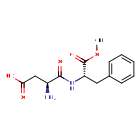
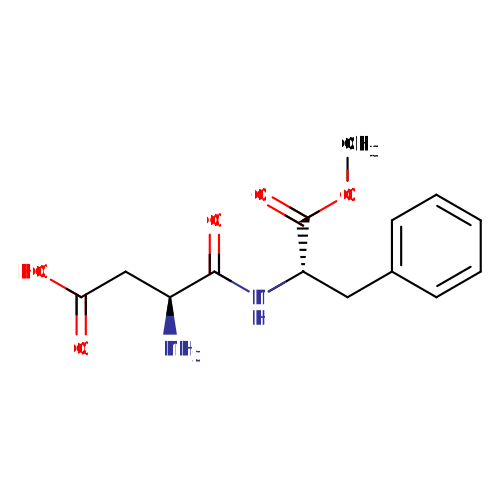
Structure for Aspartame (DB00168)
- Weight
- Average: 294.3031
Monoisotopic: 294.121571696 - Chemical Formula
- C14H18N2O5
- Synonyms
- 1-Methyl N-L-alpha-aspartyl-L-phenylalanate
- 1-methyl N-L-α-aspartyl-L-phenylalanate
- 3-Amino-N-(alpha-carboxyphenethyl)succinamic acid N-methyl ester
- 3-Amino-N-(alpha-methoxycarbonylphenethyl) succinamic acid
- 3-Amino-N-(α-carboxyphenethyl)succinamic acid N-methyl ester
- 3-Amino-N-(α-methoxycarbonylphenethyl) succinamic acid
- Asp-phe-ome
- Aspartam
- Aspartame
- Aspartamo
- Aspartamum
- Aspartylphenylalanine methyl ester
- L-Aspartyl-L-phenylalanine methyl ester
- External IDs
- E-951
- SC-18862

Pharmacology
- Indication
Used as a diet supplement and sugar substitute.
 Reduce drug development failure ratesBuild, train, & validate machine-learning modelswith evidence-based and structured datasets.Build, train, & validate predictive machine-learning models with structured datasets.
- Associated Therapies
- Contraindications & Blackbox Warnings
 Prevent Adverse Drug Events TodayTap into our Clinical API for life-saving information on contraindications & blackbox warnings, population restrictions, harmful risks, & more.Avoid life-threatening adverse drug events with our Clinical API
- Pharmacodynamics
Aspartame (L-alpha-aspartyl-L-phenylalanine methyl ester) is a low-calorie sweetener used to sweeten a wide variety of low- and reduced-calorie foods and beverages, including low-calorie tabletop sweeteners. Aspartame is composed of two amino acids, aspartic acid and phenylalanine, as the methyl ester. Aspartic acid and phenylalanine are also found naturally in protein containing foods, including meats, grains and dairy products. Methyl esters are also found naturally in many foods such as fruits and vegetable and their juices. Upon digestion, aspartame breaks down into three components (aspartic acid, phenylalanine and methanol), which are then absorbed into the blood and used in normal body processes. Neither aspartame nor its components accumulates in the body. These components are used in the body in the same ways as when they are derived from common foods.
- Mechanism of action
180 to 200 times sweeter than sucrose, it is metabolized as a protein and its subsequent amino-acids used up in there respective mechanisms.
Target Actions Organism UTaste receptor type 1 member 3 Not Available Humans UTaste receptor type 1 member 2 agonistHumans UTransient receptor potential cation channel subfamily V member 1 inducerHumans - Absorption
Absorbed in the small intestine, aspartame is metabolized and absorbed very quickly.
- Volume of distribution
Not Available
- Protein binding
Not Available
- Metabolism
Approximately 10% of aspartame (by weight) is broken down into methanol in the small intestine. Most of the methanol is absorbed and quickly converted into formaldehyde. Approximately 50% of aspartame (by weight) is broken down into phenylalanine. Approximately 40% of aspartame (by mass) is broken down into aspartic acid.
- Route of elimination
Not Available
- Half-life
At room temperature, aspartame is most stable at pH 4.3, where its half-life is nearly 300 days. At pH 7, its half-life is shortened to only a few days.
- Clearance
Not Available
- Adverse Effects
 Improve decision support & research outcomesWith structured adverse effects data, including: blackbox warnings, adverse reactions, warning & precautions, & incidence rates. View sample adverse effects data in our new Data Library!Improve decision support & research outcomes with our structured adverse effects data.
- Toxicity
Mild gastrointestinal side effects including diarrhea have been reported.
- Pathways
- Not Available
- Pharmacogenomic Effects/ADRs
- Not Available
Interactions
- Drug Interactions
- This information should not be interpreted without the help of a healthcare provider. If you believe you are experiencing an interaction, contact a healthcare provider immediately. The absence of an interaction does not necessarily mean no interactions exist.
Drug Interaction Integrate drug-drug
interactions in your softwareAcamprosate The excretion of Acamprosate can be decreased when combined with Aspartame. Acyclovir The excretion of Acyclovir can be decreased when combined with Aspartame. Adefovir dipivoxil The excretion of Adefovir dipivoxil can be decreased when combined with Aspartame. Allopurinol The excretion of Allopurinol can be decreased when combined with Aspartame. Aminohippuric acid The excretion of Aminohippuric acid can be decreased when combined with Aspartame. - Food Interactions
- Not Available
Products
 Drug product information from 10+ global regionsOur datasets provide approved product information including:dosage, form, labeller, route of administration, and marketing period.Access drug product information from over 10 global regions.
- International/Other Brands
- Aminosweet (Ajinomoto) / Canderel (Merisant) / Equal (Merisant) / Nutrasweet (NutraSweet)
- Over the Counter Products
Name Dosage Strength Route Labeller Marketing Start Marketing End Region Image แอสพาร์เทม ชนิดผง Powder 38 mg/1sachet Oral บริษัท โรงงานเภสัชกรรมแหลมทองการแพทย์ จำกัด จำกัด 2000-04-04 Not applicable Thailand 
แอสพาร์เทม เม็ด Tablet 20 mg Oral บริษัท โรงงานเภสัชกรรมแหลมทองการแพทย์ จำกัด จำกัด 2000-09-03 Not applicable Thailand - Mixture Products
Name Ingredients Dosage Route Labeller Marketing Start Marketing End Region Image HEPASELAMİN AMİNOASİT IV İNFÜZYON ÇÖZELTİSİ 500 ML SETLİ ŞİŞE Aspartame (0.9 %) + Ademetionine (0.24 %) + Adenine (0.8 %) + Ascorbic acid (0.6 %) + Biotin (0.1 %) + Calcifediol (0.9 %) + Cysteine (0.066 %) + Lysine (0.61 %) + Methionine (0.5 %) + NADH (0.45 %) + Phosphoric acid (0.115 %) + Thiamine (0.02 %) + Tryptophan (1.1 %) + Tyrosine (0.1 %) + Valine (0.77 %) + Vitamin A (0.84 %) Solution Intravenous OSEL İLAÇ SAN. VE TİC. A.Ş. 2003-12-31 Not applicable Turkey 
HEPASELAMİN AMİNOASİT IV İNFÜZYON ÇÖZELTİSİ 500 ML SETSİZ ŞİŞE Aspartame (0.9 %) + Ademetionine (0.24 %) + Adenine (0.8 %) + Ascorbic acid (0.6 %) + Biotin (0.1 %) + Calcifediol (0.9 %) + Cysteine (0.066 %) + Lysine (0.61 %) + Methionine (0.5 %) + NADH (0.45 %) + Phosphoric acid (0.115 %) + Thiamine (0.02 %) + Tryptophan (1.1 %) + Tyrosine (0.1 %) + Valine (0.77 %) + Vitamin A (0.84 %) Solution Intravenous OSEL İLAÇ SAN. VE TİC. A.Ş. 2003-12-31 Not applicable Turkey HEPATAMINE %8 500 ML(SETLI) Aspartame (0.9 %) + Ademetionine (0.24 %) + Adenine (0.8 %) + Ascorbic acid (0.6 %) + Biotin (0.1 %) + Calcifediol (0.9 %) + Cysteine (0.066 %) + Lysine (0.61 %) + Methionine (0.5 %) + NADH (0.45 %) + Phosphoric acid (0.115 %) + Sodium bisulfite (0.01 %) + Thiamine (0.02 %) + Tryptophan (1.1 %) + Tyrosine (0.1 %) + Valine (0.77 %) + Vitamin A (0.84 %) Solution Intravenous ECZACIBAŞI-BAXTER HASTANE ÜRÜNLERİ SAN.VE TİC. A.Ş. 1990-01-16 2024-01-23 Turkey HEPATAMINE %8 500 ML(SETSIZ) Aspartame (0.9 %) + Ademetionine (0.24 %) + Adenine (0.8 %) + Ascorbic acid (0.6 %) + Biotin (0.1 %) + Calcifediol (0.9 %) + Cysteine (0.066 %) + Lysine (0.61 %) + Methionine (0.5 %) + NADH (0.45 %) + Phosphoric acid (0.115 %) + Sodium bisulfite (0.01 %) + Thiamine (0.02 %) + Tryptophan (1.1 %) + Tyrosine (0.1 %) + Valine (0.77 %) + Vitamin A (0.84 %) Solution Intravenous ECZACIBAŞI-BAXTER HASTANE ÜRÜNLERİ SAN.VE TİC. A.Ş. 1990-01-16 2024-01-23 Turkey
Categories
- Drug Categories
- Amino Acids, Peptides, and Proteins
- Compounds used in a research, industrial, or household setting
- Diet, Food, and Nutrition
- Dietary Supplements
- Dipeptides
- Flavoring Agents
- Food
- Food Additives
- Food Ingredients
- OAT1/SLC22A6 inhibitors
- OAT3/SLC22A8 Inhibitors
- Oligopeptides
- Peptides
- Physiological Phenomena
- Supplements
- Sweetening Agents
- Chemical TaxonomyProvided by Classyfire
- Description
- This compound belongs to the class of organic compounds known as peptides. These are compounds containing an amide derived from two or more amino carboxylic acid molecules (the same or different) by formation of a covalent bond from the carbonyl carbon of one to the nitrogen atom of another.
- Kingdom
- Organic compounds
- Super Class
- Organic acids and derivatives
- Class
- Carboxylic acids and derivatives
- Sub Class
- Amino acids, peptides, and analogues
- Direct Parent
- Peptides
- Alternative Parents
- Phenylalanine and derivatives / Alpha amino acid esters / N-acyl-alpha amino acids and derivatives / Beta amino acids and derivatives / Amphetamines and derivatives / Fatty acid esters / Dicarboxylic acids and derivatives / Methyl esters / Amino acids / Propargyl-type 1,3-dipolar organic compounds show 7 more
- Substituents
- Alpha peptide / Alpha-amino acid ester / Alpha-amino acid or derivatives / Amine / Amino acid / Amino acid or derivatives / Amphetamine or derivatives / Aromatic homomonocyclic compound / Benzenoid / Beta amino acid or derivatives show 23 more
- Molecular Framework
- Aromatic homomonocyclic compounds
- External Descriptors
- dipeptide, methyl ester, carboxylic acid (CHEBI:2877)
- Affected organisms
- Humans and other mammals
Chemical Identifiers
- UNII
- Z0H242BBR1
- CAS number
- 22839-47-0
- InChI Key
- IAOZJIPTCAWIRG-QWRGUYRKSA-N
- InChI
- InChI=1S/C14H18N2O5/c1-21-14(20)11(7-9-5-3-2-4-6-9)16-13(19)10(15)8-12(17)18/h2-6,10-11H,7-8,15H2,1H3,(H,16,19)(H,17,18)/t10-,11-/m0/s1
- IUPAC Name
- (3S)-3-amino-3-{[(2S)-1-methoxy-1-oxo-3-phenylpropan-2-yl]carbamoyl}propanoic acid
- SMILES
- COC(=O)[C@H](CC1=CC=CC=C1)NC(=O)[C@@H](N)CC(O)=O
References
- Synthesis Reference
Josef Tsau, "Convenient to use aspartame and method of making." U.S. Patent US5582351, issued August, 1972.
US5582351- General References
- Not Available
- External Links
- Human Metabolome Database
- HMDB0001894
- KEGG Drug
- D02381
- KEGG Compound
- C11045
- PubChem Compound
- 134601
- PubChem Substance
- 46507278
- ChemSpider
- 118630
- BindingDB
- 50240005
- 1311524
- ChEBI
- 2877
- ChEMBL
- CHEMBL171679
- ZINC
- ZINC000001532132
- PharmGKB
- PA448493
- PDBe Ligand
- PME
- Wikipedia
- Aspartame
- PDB Entries
- 1a8j
- MSDS
- Download (71.9 KB)
Clinical Trials
- Clinical Trials
Phase Status Purpose Conditions Count 3 Completed Treatment Bowel preparation therapy 1 1 Completed Not Available Human Immunodeficiency Virus (HIV) Infections 1 Not Available Completed Treatment Diabetes / Hyperglycemia / Kidney Transplantation 1
Pharmacoeconomics
- Manufacturers
- Not Available
- Packagers
- Medisca Inc.
- Dosage Forms
Form Route Strength Solution Intravenous Tablet Oral 10 mg Tablet Oral 20 mg Powder, for solution 40 mg Powder Oral 3 g Powder Oral 38 mg/1sachet - Prices
Unit description Cost Unit Aspartame powder 1.68USD g DrugBank does not sell nor buy drugs. Pricing information is supplied for informational purposes only.- Patents
- Not Available
Properties
- State
- Solid
- Experimental Properties
Property Value Source melting point (°C) about 190 and 245-247 Schlatter, J.M.; US.Patent 3,492,131; January 27, 1970; assigned to G.D. Searle & Co. water solubility The solubility of aspartame in water is dependent on pH and temperature, the maximum solubility is reached at pH 2.2 (20 mg/mL at 25 °C) and the minimum solubility at pH 5.2 (pHi) is 13.5 mg/mL at 25 °C. Not Available logP -0.1 Not Available - Predicted Properties
Property Value Source Water Solubility 0.651 mg/mL ALOGPS logP -1.2 ALOGPS logP -2.2 Chemaxon logS -2.6 ALOGPS pKa (Strongest Acidic) 3.53 Chemaxon pKa (Strongest Basic) 8.53 Chemaxon Physiological Charge 0 Chemaxon Hydrogen Acceptor Count 5 Chemaxon Hydrogen Donor Count 3 Chemaxon Polar Surface Area 118.72 Å2 Chemaxon Rotatable Bond Count 8 Chemaxon Refractivity 73.22 m3·mol-1 Chemaxon Polarizability 29.56 Å3 Chemaxon Number of Rings 1 Chemaxon Bioavailability 1 Chemaxon Rule of Five Yes Chemaxon Ghose Filter No Chemaxon Veber's Rule No Chemaxon MDDR-like Rule No Chemaxon - Predicted ADMET Features
Property Value Probability Human Intestinal Absorption - 0.8218 Blood Brain Barrier - 0.5562 Caco-2 permeable - 0.8956 P-glycoprotein substrate Substrate 0.5137 P-glycoprotein inhibitor I Non-inhibitor 0.9286 P-glycoprotein inhibitor II Non-inhibitor 0.9772 Renal organic cation transporter Non-inhibitor 0.9573 CYP450 2C9 substrate Non-substrate 0.833 CYP450 2D6 substrate Non-substrate 0.8474 CYP450 3A4 substrate Non-substrate 0.6928 CYP450 1A2 substrate Non-inhibitor 0.8972 CYP450 2C9 inhibitor Non-inhibitor 0.894 CYP450 2D6 inhibitor Non-inhibitor 0.9549 CYP450 2C19 inhibitor Non-inhibitor 0.9484 CYP450 3A4 inhibitor Non-inhibitor 0.9437 CYP450 inhibitory promiscuity Low CYP Inhibitory Promiscuity 0.9792 Ames test Non AMES toxic 0.7963 Carcinogenicity Non-carcinogens 0.9284 Biodegradation Not ready biodegradable 0.7073 Rat acute toxicity 1.6896 LD50, mol/kg Not applicable hERG inhibition (predictor I) Weak inhibitor 0.9948 hERG inhibition (predictor II) Non-inhibitor 0.9467
Spectra
- Mass Spec (NIST)
- Not Available
- Spectra
- Chromatographic Properties
Collision Cross Sections (CCS)
Adduct CCS Value (Å2) Source type Source [M-H]- 172.3735177 predictedDarkChem Lite v0.1.0 [M-H]- 177.0424177 predictedDarkChem Lite v0.1.0 [M-H]- 176.0097177 predictedDarkChem Lite v0.1.0 [M-H]- 175.18747 predictedDeepCCS 1.0 (2019) [M+H]+ 171.5815177 predictedDarkChem Lite v0.1.0 [M+H]+ 176.9302177 predictedDarkChem Lite v0.1.0 [M+H]+ 175.0552177 predictedDarkChem Lite v0.1.0 [M+H]+ 177.54567 predictedDeepCCS 1.0 (2019) [M+Na]+ 171.1424177 predictedDarkChem Lite v0.1.0 [M+Na]+ 176.0215177 predictedDarkChem Lite v0.1.0 [M+Na]+ 175.7310177 predictedDarkChem Lite v0.1.0 [M+Na]+ 184.24998 predictedDeepCCS 1.0 (2019)
Targets

- Kind
- Protein
- Organism
- Humans
- Pharmacological action
- Unknown
- General Function
- Taste receptor activity
- Specific Function
- Putative taste receptor. TAS1R1/TAS1R3 responds to the umami taste stimulus (the taste of monosodium glutamate). TAS1R2/TAS1R3 recognizes diverse natural and synthetic sweeteners. TAS1R3 is essenti...
- Gene Name
- TAS1R3
- Uniprot ID
- Q7RTX0
- Uniprot Name
- Taste receptor type 1 member 3
- Molecular Weight
- 93385.155 Da
References
- Maillet EL, Cui M, Jiang P, Mezei M, Hecht E, Quijada J, Margolskee RF, Osman R, Max M: Characterization of the Binding Site of Aspartame in the Human Sweet Taste Receptor. Chem Senses. 2015 Oct;40(8):577-86. doi: 10.1093/chemse/bjv045. [Article]
- Kind
- Protein
- Organism
- Humans
- Pharmacological action
- Unknown
- Actions
- Agonist
- General Function
- Taste receptor activity
- Specific Function
- Putative taste receptor. TAS1R2/TAS1R3 recognizes diverse natural and synthetic sweeteners.
- Gene Name
- TAS1R2
- Uniprot ID
- Q8TE23
- Uniprot Name
- Taste receptor type 1 member 2
- Molecular Weight
- 95182.54 Da
References
- Overington JP, Al-Lazikani B, Hopkins AL: How many drug targets are there? Nat Rev Drug Discov. 2006 Dec;5(12):993-6. [Article]
- Imming P, Sinning C, Meyer A: Drugs, their targets and the nature and number of drug targets. Nat Rev Drug Discov. 2006 Oct;5(10):821-34. [Article]
- Xu H, Staszewski L, Tang H, Adler E, Zoller M, Li X: Different functional roles of T1R subunits in the heteromeric taste receptors. Proc Natl Acad Sci U S A. 2004 Sep 28;101(39):14258-63. Epub 2004 Sep 7. [Article]
- Cui M, Jiang P, Maillet E, Max M, Margolskee RF, Osman R: The heterodimeric sweet taste receptor has multiple potential ligand binding sites. Curr Pharm Des. 2006;12(35):4591-600. [Article]
- Kind
- Protein
- Organism
- Humans
- Pharmacological action
- Unknown
- Actions
- Inducer
- General Function
- Transmembrane signaling receptor activity
- Specific Function
- Ligand-activated non-selective calcium permeant cation channel involved in detection of noxious chemical and thermal stimuli. Seems to mediate proton influx and may be involved in intracellular aci...
- Gene Name
- TRPV1
- Uniprot ID
- Q8NER1
- Uniprot Name
- Transient receptor potential cation channel subfamily V member 1
- Molecular Weight
- 94955.33 Da
References
- Riera CE, Vogel H, Simon SA, le Coutre J: Artificial sweeteners and salts producing a metallic taste sensation activate TRPV1 receptors. Am J Physiol Regul Integr Comp Physiol. 2007 Aug;293(2):R626-34. Epub 2007 Jun 13. [Article]
Transporters
- Kind
- Protein
- Organism
- Humans
- Pharmacological action
- Unknown
- Actions
- Inhibitor
- General Function
- Sodium-independent organic anion transmembrane transporter activity
- Specific Function
- Involved in the renal elimination of endogenous and exogenous organic anions. Functions as organic anion exchanger when the uptake of one molecule of organic anion is coupled with an efflux of one ...
- Gene Name
- SLC22A6
- Uniprot ID
- Q4U2R8
- Uniprot Name
- Solute carrier family 22 member 6
- Molecular Weight
- 61815.78 Da
References
- Jung KY, Takeda M, Kim DK, Tojo A, Narikawa S, Yoo BS, Hosoyamada M, Cha SH, Sekine T, Endou H: Characterization of ochratoxin A transport by human organic anion transporters. Life Sci. 2001 Sep 21;69(18):2123-35. [Article]
- Tsuda M, Sekine T, Takeda M, Cha SH, Kanai Y, Kimura M, Endou H: Transport of ochratoxin A by renal multispecific organic anion transporter 1. J Pharmacol Exp Ther. 1999 Jun;289(3):1301-5. [Article]
- Kind
- Protein
- Organism
- Humans
- Pharmacological action
- Unknown
- Actions
- Inhibitor
- General Function
- Sodium-independent organic anion transmembrane transporter activity
- Specific Function
- Plays an important role in the excretion/detoxification of endogenous and exogenous organic anions, especially from the brain and kidney. Involved in the transport basolateral of steviol, fexofenad...
- Gene Name
- SLC22A8
- Uniprot ID
- Q8TCC7
- Uniprot Name
- Solute carrier family 22 member 8
- Molecular Weight
- 59855.585 Da
References
- Jung KY, Takeda M, Kim DK, Tojo A, Narikawa S, Yoo BS, Hosoyamada M, Cha SH, Sekine T, Endou H: Characterization of ochratoxin A transport by human organic anion transporters. Life Sci. 2001 Sep 21;69(18):2123-35. [Article]
- Kind
- Protein
- Organism
- Humans
- Pharmacological action
- Unknown
- Actions
- Inhibitor
- General Function
- Sodium-independent organic anion transmembrane transporter activity
- Specific Function
- Mediates saturable uptake of estrone sulfate, dehydroepiandrosterone sulfate and related compounds.
- Gene Name
- SLC22A11
- Uniprot ID
- Q9NSA0
- Uniprot Name
- Solute carrier family 22 member 11
- Molecular Weight
- 59970.945 Da
References
- Babu E, Takeda M, Narikawa S, Kobayashi Y, Enomoto A, Tojo A, Cha SH, Sekine T, Sakthisekaran D, Endou H: Role of human organic anion transporter 4 in the transport of ochratoxin A. Biochim Biophys Acta. 2002 Jun 12;1590(1-3):64-75. [Article]

Drug created at June 13, 2005 13:24 / Updated at April 09, 2024 18:12